Bitcoin's Post-Halving Reality Check: Why This Cycle Is Breaking the Pattern
Every previous Bitcoin halving triggered a massive bull run within 12 months. The 2024 halving hasn't. Here's why this cycle is different and what it means for your portfolio.
Hynexly
The Playbook Everyone Memorized
If you've been in crypto for more than five minutes, you know the halving playbook. It goes like this:
- Bitcoin halving happens
- Supply shock kicks in
- Bull run follows within 6-12 months
- Price goes 5-10x from pre-halving levels
- Euphoria, mania, crash
- Repeat
It worked in 2012 (price went from $12 to $1,100). It worked in 2016 ($650 to $20,000). It worked in 2020 (~$8,700 to $69,000). Three for three. The most reliable pattern in all of crypto.
So when the fourth halving hit in April 2024, everyone loaded up and waited for the fireworks.
We're now nearly two years post-halving, and... the returns have been the most modest of any cycle. Bitcoin is hovering around $95,000-105,000. Solid, sure. But it's not the face-melting rally that the halving faithful were expecting.
The Chart Says It All
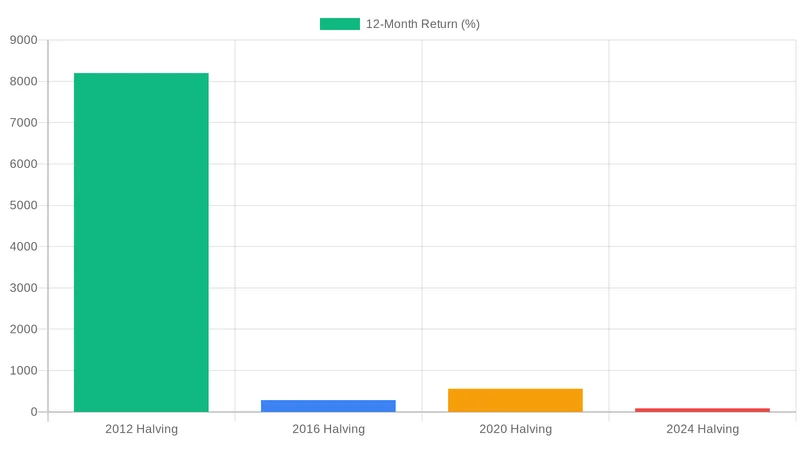
The pattern is clear: each halving cycle has produced diminishing returns. The 2012 halving saw thousands of percent in gains. 2016 delivered around 3,000%. 2020 gave us roughly 550%. And this cycle? We're looking at maybe 45-60% from the halving price to current levels.
Still positive. Still beating the S&P 500. But a far cry from the "guaranteed 5x" narrative that crypto Twitter was pushing.
What's Different This Time
1. The Supply Shock Was Pre-Priced
This is the biggest factor, and it's counterintuitive. In previous cycles, the halving was a catalyst that surprised the market. In 2024, every hedge fund, family office, and retail trader on earth knew exactly when it was happening and what it historically meant.
The result? A massive rally before the halving, not after. Bitcoin ran from $40,000 to $73,000 in the months leading up to April 2024. The smart money front-ran the event, and by the time the halving actually occurred, much of the supply shock was already priced into the market.
2. ETFs Changed the Game
The approval of spot Bitcoin ETFs in January 2024 was genuinely transformative — but not in the way most people expected for the halving narrative.
ETFs brought in a wave of institutional capital that smoothed out Bitcoin's price action. Before ETFs, Bitcoin traded on sentiment, leverage, and FOMO cycles. Now, a significant chunk of demand comes from pension funds, wealth managers, and passive allocators who buy steadily regardless of halvings or technical patterns.
This institutional layer acts as both a floor (more consistent buying) and a ceiling (more sophisticated selling into strength). The result is less volatility and more efficient pricing — which means less room for those explosive post-halving rallies.
3. Bitcoin Is Just... Big Now
Here's simple math that people overlook. When Bitcoin had a $15 billion market cap in 2016, it took relatively little capital to push the price 10x. At a $2 trillion market cap, you need massively more capital to generate the same percentage move.
It's the difference between pushing a kayak and pushing an aircraft carrier. The physics just don't work the same way.
4. Macro Headwinds Are Real
Previous halving cycles coincided with accommodative monetary policy. The 2020 cycle had the tailwind of zero interest rates and trillions in stimulus. This cycle? We've got the Fed stuck at 4.5%, geopolitical conflict pushing up oil prices, and a general risk-off tone in global markets.
Bitcoin's correlation with risk assets has increased as institutional adoption has grown. That means macro matters more than it used to.
Is the Halving Narrative Dead?
No — but it needs updating.
I think the halving still matters as a fundamental supply dynamic. Miners receiving 3.125 BTC instead of 6.25 BTC per block is a real reduction in sell pressure. Over time, that scarcity effect compounds.
But the idea that you can simply "buy before the halving, sell after the blowoff top, and retire" is over. The market has matured beyond that simple playbook.
Here's how I'd reframe it:
- The halving creates a long-term supply floor, not a short-term price catalyst.
- Each cycle will produce lower (but still positive) returns as the market cap grows and the asset matures.
- The timing of the rally is less predictable because institutional flows, ETF dynamics, and macro conditions now dominate over the supply schedule.
What Bitcoin Needs for Its Next Leg Up
If you're wondering what could push Bitcoin past $120K-150K, here's what I'm watching:
Fed rate cuts. Nothing would juice risk assets — including Bitcoin — like the beginning of a real easing cycle. If the Fed cuts in Q3/Q4 2026, Bitcoin could see a significant move.
ETF flow acceleration. The current steady-state flows are supportive, but a surge in institutional allocation — say, a major sovereign wealth fund announcement — could break the market higher.
Regulatory clarity. Clear crypto legislation (beyond the GENIUS Act for stablecoins) that gives institutions confidence to increase their allocations.
Emerging market adoption. Bitcoin is seeing growing adoption as a savings vehicle in countries with unstable currencies. This demand is steady but growing.
My Take
I own Bitcoin. I'm bullish on Bitcoin long-term. But I'm also realistic about this cycle.
The days of 10x post-halving returns are behind us. Bitcoin is transitioning from a speculative asset to an institutional-grade store of value, and that transition comes with more modest — but more sustainable — returns.
I think Bitcoin at $95-105K is fairly priced for the current environment. The next meaningful move requires a macro catalyst (rate cuts) or a structural shift (major new institutional adoption). Until then, expect choppy, range-bound price action.
The halving pattern isn't dead. It's just growing up.
Disclaimer: I hold Bitcoin. This is not financial advice. Always do your own research before making investment decisions.