Green Transition
How CBAM Ties Its Certificate Price to the EU ETS Allowance Market
Built from EU Commission pages: how CBAM's 2026 definitive regime, ETS-linked certificate pricing, publication timing, and compliance calendar fit together before any importer-impact claim.
Thesis
(Source: European Commission, Carbon Border Adjustment Mechanism)
The discretionary-tariff framing was the first thing to go. CBAM is often described as Brussels setting an import levy at will, and the Commission's own pages simply would not support that claim — checking it is where this note started. What survived the regime page and the first certificate price notice were four separate threads: the 2023-2025 transition versus the 2026 definitive regime, a price tied to weekly average EU ETS auction prices, the 7 April 2026 publication date, and the EU ETS reporting and surrender calendar. Nothing got marked solid in our working notes unless one of those four official pages stated it directly.
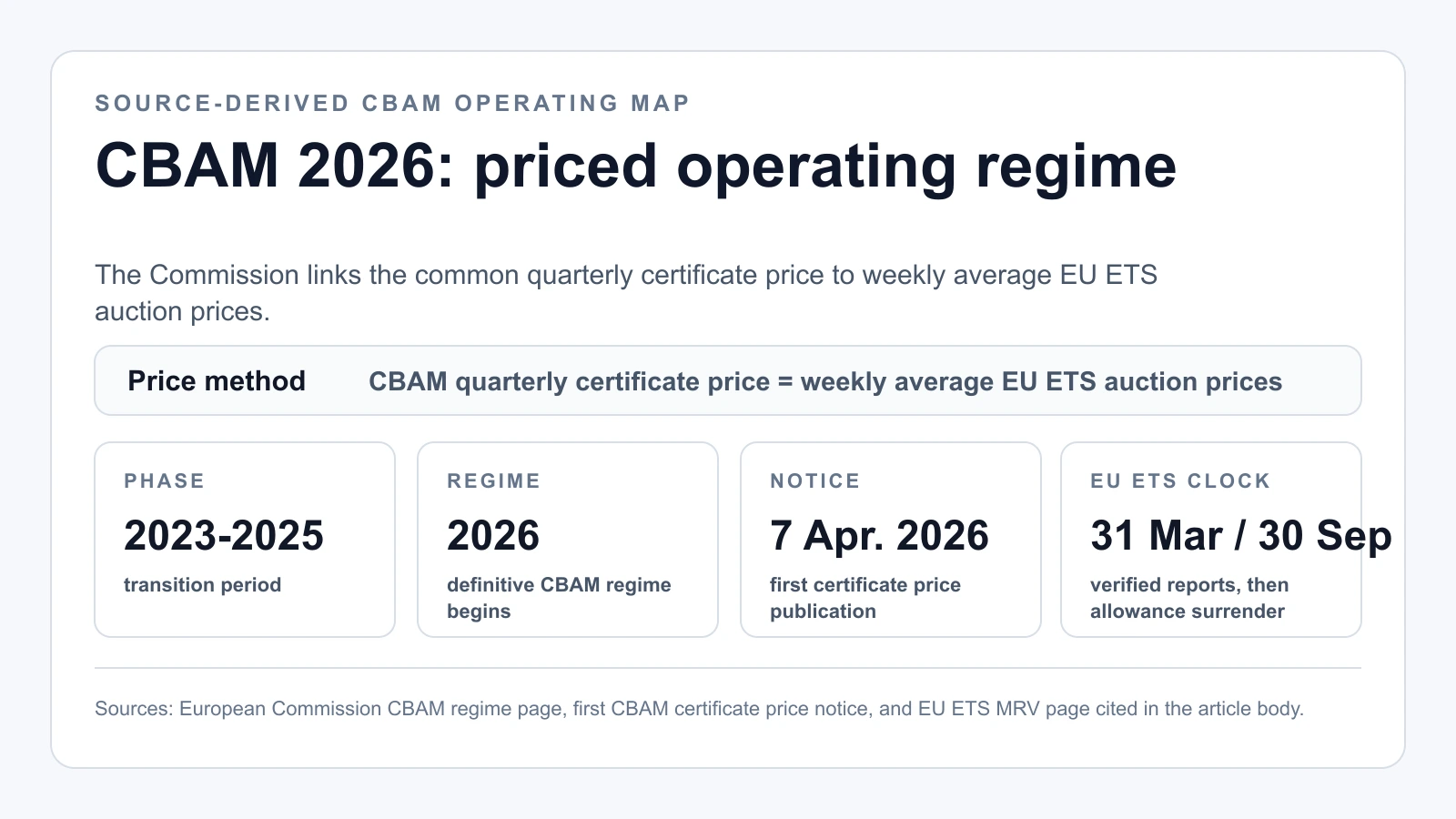
For years the easiest thing to say about CBAM was that Europe was building a carbon border mechanism and importers should brace for it, with little operating detail attached. That framing is now out of date. The Commission pages put four concrete anchors on the calendar: a transitional phase that ran from 2023 to 2025, a definitive regime that started in 2026, a first certificate price published 7 April 2026, and an EU ETS compliance clock with reporting due 31 March and surrender due 30 September.
Those dates also sequence cleanly. The first CBAM certificate price lands on 7 April 2026 — within a week of the 31 March EU ETS reporting deadline — so the inaugural price is set against fresh verified-emissions data rather than a stale reference. That matters because it changes the reading frame. CBAM is no longer just a future compliance story. It is now a live operating mechanism with a defined pricing method, dated publication cycle, and direct linkage to the EU allowance market.
Source Evidence Snapshot
The hero visual is an operating map. The source table below carries the factual load, with each row assigned a different job: regime status, price linkage, publication timing, and the EU ETS compliance clock.
| Source | What it proves | Why it matters |
|---|---|---|
| European Commission, Carbon Border Adjustment Mechanism | The transitional phase ran from 2023 to 2025, and the definitive CBAM regime starts in 2026. | This moves the topic from a future policy concept into a live operating framework. |
| European Commission, first CBAM certificate price notice | The common quarterly CBAM certificate price is based on weekly average EU ETS auction prices. | The price mechanism is linked to the EU allowance market rather than a discretionary tariff table. |
| European Commission, first CBAM certificate price notice | The first certificate price was scheduled to be published on 7 April 2026. | A dated publication point makes the mechanism monitorable quarter by quarter. |
| European Commission Climate Action, EU ETS monitoring and reporting | Operators submit verified reports by 31 March and surrender allowances by 30 September. | The EU ETS compliance clock remains useful context because CBAM pricing is tied back to EU ETS allowance prices. |
That distinction is useful for AdSense review quality as well as reader clarity: the graphic summarizes the mechanism, while the Commission links carry the factual burden.
What These Sources Prove
1. The definitive phase is live
The Commission language is explicit: the transition period was not open-ended. It ended with 2025, and the definitive regime began in 2026. That sounds procedural, but it is the key step that moves CBAM from a reporting rehearsal into a priced mechanism.
2. Certificate pricing is not arbitrary
The pricing notice matters because it removes a common shortcut in CBAM commentary. The Commission does not describe the certificate price as a political guess or a one-off tariff schedule. It ties the common quarterly price to the weekly average auction prices of EU ETS allowances. That makes CBAM easier to read through the existing EU carbon-market structure.
3. The publication calendar is real, not theoretical
The same notice says the first certificate price would be published on 7 April 2026. Once you have a dated publication point, the mechanism becomes easier to monitor quarter by quarter instead of treating it as a vague future policy risk.
4. EU ETS process still matters for context
The EU ETS MRV page remains the better reference for the wider carbon-market calendar: verified reporting by 31 March and allowance surrender by 30 September. Those dates are not the whole CBAM rulebook, but they are still useful context because the CBAM price methodology is explicitly tied back to EU ETS allowance pricing.
What These Sources Do Not Prove
- They do not prove a uniform pass-through rate into every imported product.
- They do not prove that downstream-product extension is already implemented.
- They do not prove the exact earnings impact for any one steel, cement, fertilizer, or industrial stock.
That distinction matters. The Commission sources above support regime status, price linkage, and calendar mechanics. They do not support sweeping claims about every trade flow or every equity winner and loser.
A Better 2026 Reading Frame for CBAM
The most useful way to read CBAM now is as infrastructure rather than ideology.
First, verify regime status. Second, verify how pricing is computed. Third, verify when official numbers are published. Only after those steps should you move into company-level questions about embedded emissions, supplier mix, import exposure, or whether a specific business can pass costs through.
That workflow is slower than slogan-driven commentary, but it is more durable. It prevents the common mistake of turning a real rules-based mechanism into a broad political narrative with no operating detail.
Monitoring Workflow
If you want this topic to stay decision-useful, the refresh routine is simple:
- Recheck the Commission's main CBAM regime page for scope or implementation updates.
- Recheck the Commission pricing notice whenever the common quarterly certificate price is updated.
- Recheck the EU ETS MRV page when interpreting carbon-market timing and compliance rhythm.
- Only then update sector or stock-level exposure views.
What Changes the CBAM Read
The most important 2026 shift is not rhetorical. It is operational. The Commission now presents CBAM as a definitive regime with an explicit start date, a dated publication cycle, and a pricing method tied to EU ETS auction prices.
That is enough to change how investors and operating teams should read the mechanism. Start with the rule text and the dated price notices. Add company interpretation only after the infrastructure is clear.
Related reads: