Hynexly
Market & Macro

Palantir Stock in 2026: Short Interest Is Still Heavy, but Coding Agents May Split Software Winners from Losers

A Nasdaq quote response captured on April 13, 2026 still showed PLTR around $128.06 and a market cap above $306 billion. The official Nasdaq short-interest data still showed more than 50.5 million shares sold short, but only 1.21 days to cover. The real 2026 debate is not whether Palantir can squeeze shorts; it is whether coding agents compress generic software multiples while making Palantir's deployment-heavy control layer more valuable.

H

Hynexly

·10 min read·
PalantirPLTRshort interestsoftware stocksCodexClaude Code
Palantir Q4 2025 investor-presentation excerpt highlighting total revenue growth, U.S. commercial growth, and adjusted operating income

(Sources: Nasdaq official quote API, Nasdaq official quote summary API, Nasdaq official short-interest API, Palantir Q4 2025 investor presentation PDF, OpenAI Codex page, Anthropic Claude Code, ServiceNow Q4 2025 results, CrowdStrike FY2026 results)

The cleanest mistake investors can make with Palantir in 2026 is to turn it into the wrong kind of debate.

Related reading: The Fed Rate Cut Puzzle in 2026: Timing, Data Triggers, and Portfolio Discipline | How to Actually Invest in Carbon Credits in 2026 | How to Start Investing in US Stocks: A Safer Beginner Framework

The wrong debate is whether PLTR is simply a meme-driven squeeze stock that goes up because retail attention is hot and the short base keeps getting punished. The official Nasdaq short-interest data does not really support that framing. The latest settlement-date response still showed more than 50.6 million shares sold short, which is large in absolute terms, but it also showed only about 1.21 days to cover. That is not what a cornered short base usually looks like.

The harder and more relevant debate is whether AI coding agents change the ranking of software businesses. If tools like Codex and Claude Code can absorb more repetitive implementation work, then generic software categories that mainly monetize developer effort, light workflow abstraction, or narrow seat-based productivity layers can get pressured. At the same time, the software companies that sit closer to the control plane of real operations can become more valuable, not less.

Palantir belongs in that second discussion.

Source Evidence Snapshot

Nasdaq official quote response excerpt for PLTR showing last sale price, market cap, and average volume
Source capture: Nasdaq official quote APIs, captured 2026-04-13. The highlighted fields show PLTR at $128.06, market cap at 306,149,291,251, and average volume at 53,187,326. Quote API | Summary API.

The current quote frame already tells you how hard this stock is to own. A company trading near $128.06 with a market cap above $306 billion is already priced as something closer to a category winner than a normal enterprise-software name. That does not mean the stock cannot go higher. It does mean the business has to justify a very expensive narrative.

Nasdaq official short-interest response excerpt for Palantir showing the most recent settlement date, short interest, and days to cover
Source capture: Nasdaq official short-interest API, captured 2026-04-13. The highlighted fields show 50,576,677 shares sold short at the March 31, 2026 settlement date and 1.212798 days to cover. Open source.

That short-interest profile matters because it changes the right lens. Yes, more than 50 million shares is still a meaningful skeptical position. But only 1.21 days to cover means this is not the classic "the stock can only go up because shorts are trapped" setup. The cleaner read is that Palantir still has a large disagreement built into the stock, while liquidity is high enough that the disagreement has not turned into panic.

In other words, this is still an execution story, not a squeeze story.

Palantir Q4 2025 investor-presentation excerpt showing revenue growth, U.S. commercial growth, and adjusted operating income
Source capture: Palantir Q4 2025 investor presentation PDF, page 4, captured 2026-04-13. The marked rows show revenue growth to $1.41 billion, U.S. commercial revenue growth to $507 million, and adjusted operating income of $798 million. Open source.

This is where the stock earns the right to stay in the conversation. The official Q4 2025 presentation said revenue grew 70% year over year to $1.41 billion, while U.S. commercial revenue grew 137% to $507 million. That is not mature-software behavior. It is unusually fast growth for a business that is already producing real cash and operating leverage.

The same page also showed adjusted operating income of $798 million, which matters because it separates Palantir from a lot of fast-growing software names that still ask investors to accept margin pain as the price of future relevance.

Palantir Q4 2025 investor-presentation table showing total RPO, long-term RPO, and billings
Source capture: Palantir Q4 2025 investor presentation PDF, page 31, captured 2026-04-13. The marked figures show total RPO of 4.21, long-term RPO of 2.59, and billings of 1,489. Open source.

RPO is one of the reasons Palantir deserves a different conversation from generic AI-sentiment trades. Total RPO reached $4.21 billion, long-term RPO reached $2.59 billion, and billings reached $1.489 billion. Those figures do not prove the stock is cheap. They do show that demand is not just narrative-driven. There is real contracted work sitting behind the story.

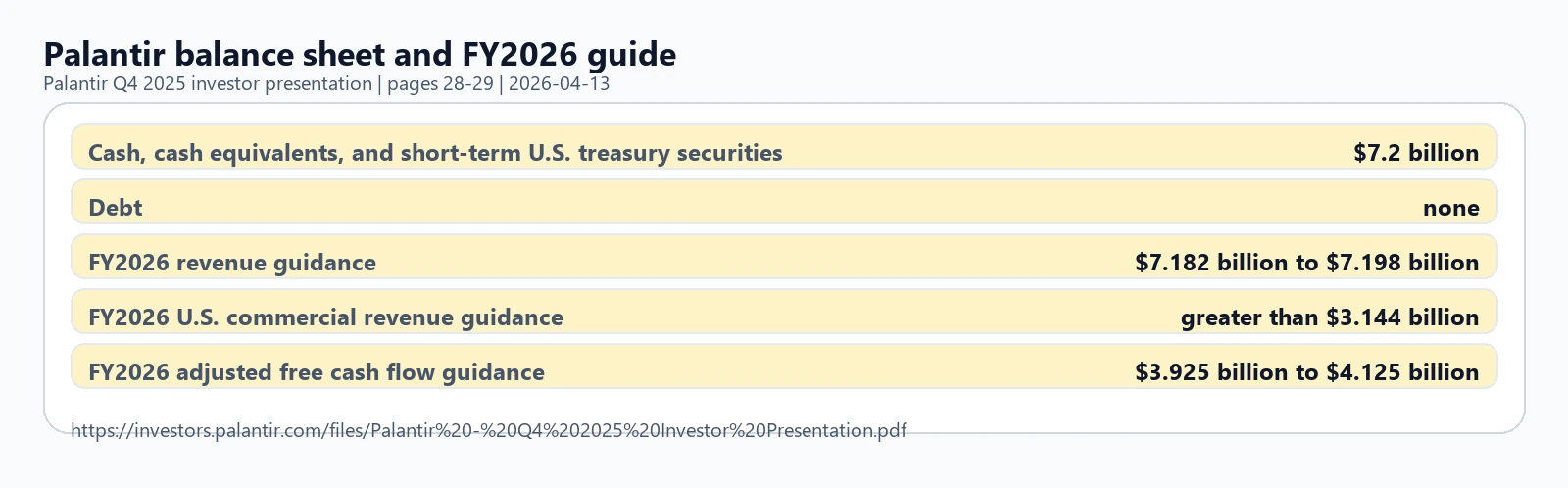
Palantir investor-presentation excerpts showing cash, no debt, and FY2026 guidance
Source capture: Palantir Q4 2025 investor presentation PDF, pages 28-29, captured 2026-04-13. The marked figures show $7.2 billion in cash, no debt, FY2026 revenue guidance of $7.182 billion to $7.198 billion, U.S. commercial revenue guidance above $3.144 billion, and adjusted free-cash-flow guidance of $3.925 billion to $4.125 billion. Open source.

The balance-sheet and guidance frame is probably the single best moat signal in the whole package. Palantir ended Q4 2025 with $7.2 billion in cash and no debt, then guided FY2026 revenue to $7.182 billion to $7.198 billion and adjusted free cash flow to $3.925 billion to $4.125 billion.

That gives Palantir something many AI-linked software names do not have: the ability to invest heavily without depending on capital markets or dilution to validate the next leg of the story.

Official OpenAI Codex and Anthropic Claude Code pages showing that coding agents can read code, write changes, run tests, and help ship software
Source capture: Official OpenAI Codex and Anthropic Claude Code pages, captured 2026-04-13. The pages show coding agents positioned as tools that can understand codebases, write changes, run tests, and help ship software. OpenAI source | Anthropic source.

These official pages are the reason the software debate is changing. The question is no longer whether coding agents are real. The question is which business models they compress first.

Coding agents should pressure parts of software, but not all parts equally

The most exposed categories are the ones that mostly organize repetitive implementation labor.

If a product's value is close to "we help engineers write, review, route, or patch ordinary code a bit faster," then AI coding agents put real pressure on that pricing power. Some narrow developer tools, light workflow wrappers, and seat-heavy software layers are vulnerable because the agent can absorb a meaningful share of the job the user used to pay for.

But that does not mean every software multiple should compress together.

The companies that are less exposed are the ones that sell one or more of these things:

  • hard-to-replace operational workflows,
  • policy and governance layers,
  • data integration at enterprise depth,
  • always-on control surfaces,
  • deployment trust in regulated environments.

That is why security vendors are not the obvious losers of coding-agent adoption. If anything, more AI-generated code and more autonomous software behavior expand the attack surface. Control planes, telemetry, identity, and response layers become more necessary when more software gets shipped faster.

Palantir is not a pure cybersecurity company, but it sits closer to that "control layer" bucket than to a generic seat-based software bucket. Its value is not just that users log in and type. Its value is that data, workflows, decisions, and operational coordination are wired into a system organizations depend on.

Palantir's moat is not just AI branding; it is deployment depth

Palantir's moat is easiest to describe by saying what it is not.

It is not primarily a low-friction productivity SaaS tool sold on convenience. It is not a narrow developer utility whose value disappears when code gets cheaper. It is not a pure cloud-consumption reseller either.

What it does sell is harder to dislodge:

  • ontology and data-modeling layers that become embedded in real workflows,
  • government and regulated-enterprise trust,
  • operational deployment depth rather than surface-level usage,
  • a financial profile strong enough to keep compounding through the cycle.

That is why the U.S. commercial number matters so much. The market already assumed Palantir could win sensitive public-sector work. The more important proof is that commercial customers are adopting it quickly enough to keep the moat from being "government only." A 137% jump in U.S. commercial revenue is a strong signal that the company is building more than a policy narrative.

Compared with other enterprise-software leaders, Palantir's edge is the control layer plus dual-market trust

The right comparison is not "is Palantir better than every software company." The right comparison is what type of software it resembles most.

ServiceNow remains one of the strongest enterprise workflow platforms in the public market. Its official Q4 2025 results showed subscription revenue of $3.466 billion, current RPO of $12.85 billion, and total RPO of $28.2 billion. That is the benchmark for large-scale workflow durability. Palantir is smaller, but the comparison is useful because both businesses live above raw infrastructure and inside enterprise process.

CrowdStrike is a different but equally relevant comparison. Its official FY2026 results showed revenue of $1.31 billion in the quarter and ending ARR of $5.25 billion. CrowdStrike's bull case is that AI makes security-control infrastructure more essential, not less. That same logic supports Palantir, even though the domain is different. More agents, more models, and more machine-generated decisions increase the need for monitoring, governance, and execution systems.

So Palantir's moat versus many software peers is not that it has the highest margins or the largest RPO pool in the whole sector. Its edge is that it combines:

  • government-grade trust,
  • fast commercial adoption,
  • workflow depth,
  • balance-sheet strength,
  • and a product layer that sits above raw code generation.

That combination is harder to commoditize than a narrow software seat.

What the stock still has to prove

None of this makes PLTR cheap.

A stock carrying a market value above $306 billion is already priced for a long runway. Even with strong numbers, Palantir still has to prove that:

  • commercial adoption stays fast after the current enthusiasm wave,
  • margins remain resilient as deployment scales,
  • AI excitement keeps converting into durable workflow expansion rather than temporary pilot activity,
  • and the company can justify a multiple that leaves limited room for disappointment.

That is where short interest still matters. More than 50.5 million shares sold short means a meaningful group of investors still thinks the valuation is ahead of itself. The Nasdaq data says that skepticism is real. It just does not look like a squeeze setup yet.

Bottom line

The strongest Palantir bull case in 2026 is not that shorts will be forced out. It is that AI coding agents may split the software market into two buckets.

One bucket contains businesses whose main job is to help humans produce code or move routine digital work around more efficiently. Those can get pressured.

The other bucket contains businesses that become more important as software output, machine autonomy, and enterprise complexity rise. Palantir is much closer to that second bucket. The official numbers support the case: high growth, strong U.S. commercial acceleration, large RPO, massive cash, no debt, and enough free-cash-flow guidance to fund the next stage of the business without relying on narrative alone.

That does not make PLTR safe. It does make the stock much more interesting than a simple short-squeeze or AI-meme label suggests.

Frequently Asked Questions

The absolute short-interest count is still large, but Nasdaq's latest official data showed only about 1.21 days to cover. That looks more like ongoing skepticism than a trapped short base.

Coding agents can pressure narrower software categories that monetize repetitive implementation work. Palantir is less exposed because its value sits in ontology, data integration, workflow deployment, and decision systems rather than per-seat coding convenience.

The cleaner view is that security-control vendors are less exposed, because more AI-generated code and agent activity usually increase the need for policy enforcement, telemetry, and response infrastructure.

Sign in to like and repost

Share:

Community

Turn this Market & Macro article into a discussion

Post a quick reaction, add a counterpoint, or point readers to the next datapoint worth watching.

Related Articles

Market & Macro

Palo Alto Networks Stock in 2026: Coding Agents Raise the Stakes, but They Do Not Replace the Security Control Plane

PANW traded around $155.73 in the captured Google Finance quote panel, while Palo Alto Networks' official fiscal Q2 2026 release showed $2.6 billion of revenue, $6.3 billion of Next-Generation Security ARR, and $16.0 billion of remaining performance obligation. The more important 2026 question is whether Claude Code and Codex can compress software spending broadly, or whether they actually make platform security vendors like Palo Alto Networks more necessary.

Market & Macro

SpaceX IPO in 2026: Korea's ETF Rush Is Real, but the S-1 Still Isn't Public

Reuters reported that SpaceX is preparing an early-June roadshow, a June retail-investor event, and a deal that could raise $75 billion at up to a $1.75 trillion valuation. Korea Times reported that Korean asset managers are already racing to package the theme into ETFs. The harder truth is that the draft filing is still nonpublic, so retail excitement is running ahead of public disclosure.

Market & Macro

Robinhood Stock in 2026: Crypto Bills Help, but Tokenized Securities Are the Bigger Rerating Bet

HOOD traded around $71.83 in the captured quote snapshot, while Robinhood's latest visible earnings panel showed Q4 2025 revenue of $1.28 billion and net income of $605 million. The more interesting 2026 question is whether crypto legislation and tokenized securities can make Robinhood deserve more than a standard retail-broker multiple.

Energy, climate, and global market insights. We track the intersection of clean energy transition, commodity markets, and macro trends to help investors stay ahead.

Comments (0)

Sign in with Google to leave a comment

No comments yet. Be the first to share your thoughts!

We use cookies for Google Analytics and Google AdSense to improve your experience. Privacy Policy