Green Transition
Plug Power Stock in 2026: Revenue Repair Versus Cash Runway
Plug Power's Q4 and full-year 2025 release showed 12.9% revenue growth to about $710 million, a return to positive quarterly gross profit, and $368.5 million of unrestricted cash. The 2026 issue is whether margin repair and asset monetization can reduce cash burn enough to extend the runway.
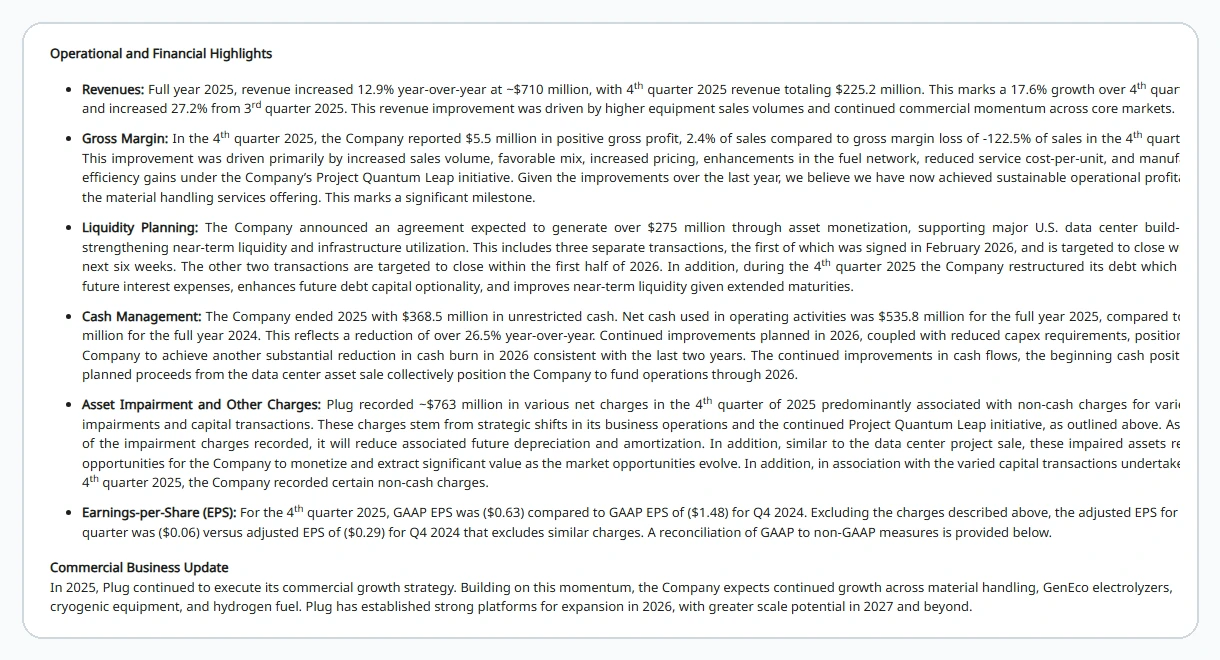
(Sources: Google Finance quote page for Plug Power, Plug Power Reports Q4 and Full Year 2025 Results with Strong Sales Growth and Margin Expansion)
Thesis
Plug Power in 2026 is not just a hydrogen-market size debate. The immediate test is whether the company has improved operations enough to keep its liquidity plan credible.
Related reading: Carbon Credit Exposure in 2026: Product Structure and Diligence Questions | Fed Rate Outlook in 2026: Data Triggers Before Cuts | U.S. Stock Investing in 2026: Broker Checks Before Stock Selection
The official Q4 and full-year 2025 release gives a more concrete answer than the older hydrogen-economy narrative ever did. Plug Power said revenue increased 12.9% year over year to about $710 million in 2025, with fourth-quarter revenue of $225.2 million. It also reported $5.5 million of positive gross profit in Q4, equal to 2.4% of sales. Those are real operating improvements.
But the same release says unrestricted cash ended 2025 at $368.5 million, while net cash used in operating activities still totaled ($535.8 million) for the year. Plug also said an asset-monetization agreement is expected to generate more than $275 million. That is the full equity setup now: better revenue and margins, but still a balance-sheet case.
The positive case is that the worst margin damage is finally behind the company. The cautious case is that the cash-burn reduction still has to keep working quarter after quarter, not just on one earnings release.
Source Evidence Snapshot
The hero image already carries Plug Power's Q4 and full-year 2025 operational highlights. The body evidence stack avoids repeating that image and keeps the quote context and cash-flow stress as separate checks.
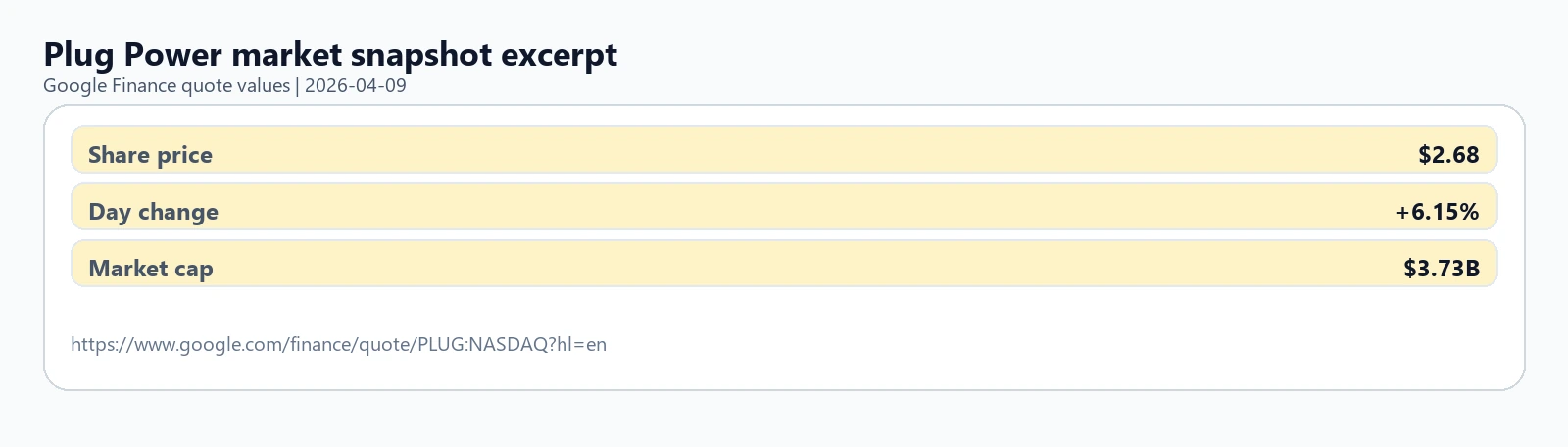
The quote snapshot shows why expectations are still low. Plug traded at $2.68, up 6.15% on the day in the captured view, with a market cap of about $3.73 billion. For a company trying to finance a hydrogen buildout, that valuation means the market is still treating PLUG as a turnaround with real funding risk, not as a clean-energy company that has already settled the balance-sheet question.
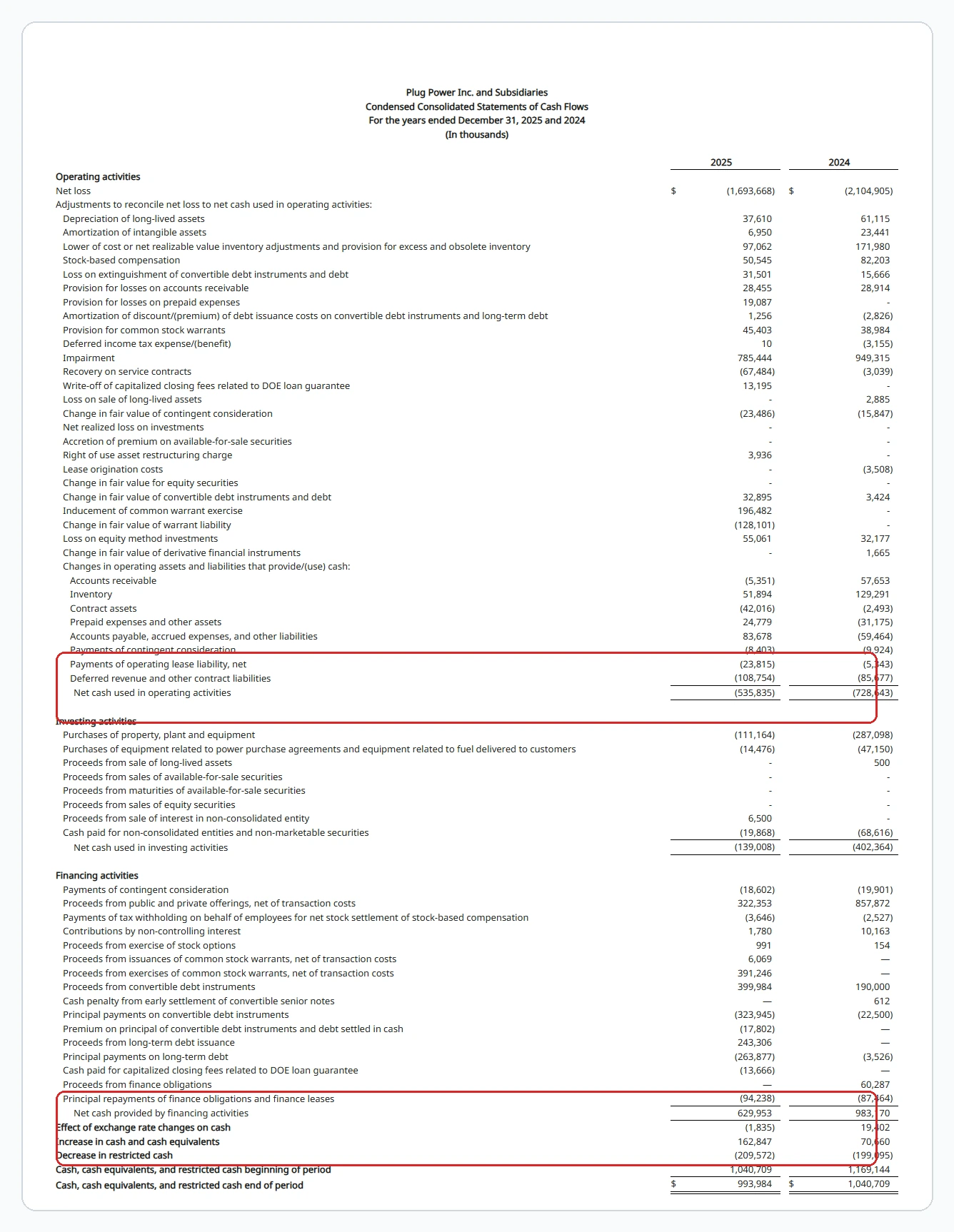
The cash-flow statement is the reason the stock cannot be judged on headline revenue alone. Plug said net cash used in operating activities improved to ($535.8 million) in 2025 from ($728.6 million) in 2024. That is a real improvement, but it still leaves the company with a funding equation that depends on continued burn reduction and successful asset monetization.
What the Street is Pricing
The quote snapshot shows a stock still priced like a financing-sensitive turnaround. That does not make the equity cheap or expensive by itself; it shows that the market has not yet treated Plug as a clean-energy compounder with a solved balance sheet.
In practical terms, the public-market setup is binary around execution. If margin repair and asset monetization keep reducing cash burn, the equity can earn more attention. If cash use stays too high relative to unrestricted cash, the revenue recovery will not be enough to carry the stock narrative.
Revenue and Margin Repair Finally Moved in the Right Direction
The strongest part of the quarter is that Plug finally showed two things investors had been waiting to see together: higher revenue and positive quarterly gross profit.
Revenue of $225.2 million in Q4 and roughly $710 million for the year is not enough by itself to settle the hydrogen debate. What matters more is that Plug said positive Q4 gross profit reached $5.5 million, or 2.4% of sales, after a period when gross margins had been deeply negative.
That does not prove the turnaround is complete. It does show that better mix, pricing, fuel-network improvements, and service-cost reductions can change the direction of the business. The company explicitly tied the improvement to increased sales volume, favorable mix, increased pricing, and cost-per-unit reduction under Project Quantum Leap.
Plug also said electrolyzer revenue reached a record $187 million in 2025 and referenced an approximate $8 billion global sales funnel. Those lines matter because they suggest there is still a commercial business behind the hydrogen case, not just a capital-markets narrative.
Liquidity Is Better Framed, but It Is Not Comfortable Yet
Investors do not need to guess what the main bear point is. The company ended 2025 with $368.5 million of unrestricted cash, while full-year operating cash outflow remained ($535.8 million).
That is why the $275+ million asset-monetization agreement matters so much. Plug is effectively telling investors that operating improvement alone is not the only lever. It also needs liquidity transactions and reduced capex requirements to extend the runway.
The release frames this as a bridge to 2026. That may be fair. But the equity still reads like a balance-sheet-sensitive turnaround until multiple quarters show that the cash-burn trend is really improving, not just bouncing around on one report.
The Hydrogen Case Now Depends on Execution, Not Hype
The cleaner way to read Plug in 2026 is to stop asking whether hydrogen is exciting and start asking whether Plug can execute inside the parts of the market that are actually working.
The company highlighted engineering and project-planning milestones with Allied Green Ammonia, a 55-megawatt GenEco electrolyzer supply and service selection with Carlton Power across three UK projects, and an approximate 300 megawatts of GenEco electrolyzers deployed across four continents. Those are useful proof points because they show commercial traction beyond legacy optimism.
Still, none of those milestones erase the capital-intensity problem. Hydrogen infrastructure can become a real business and still be a difficult stock if the equity has to keep funding the gap before profits stabilize.
That is why PLUG still screens as a high-volatility turnaround rather than a clean compounder. The operating profile improved. The financing case still has to earn more trust.
Risks to the Thesis
The first risk is that positive Q4 gross profit does not persist. One profitable gross-profit quarter is useful evidence, but it does not yet prove that pricing, mix, fuel-network efficiency, and service-cost reductions will hold through a full demand cycle.
The second risk is liquidity execution. Asset monetization can extend the runway, but the stock still needs operating cash outflow to fall at the same time. If those two pieces diverge, the market can quickly return to dilution and refinancing concerns.
The third risk is project conversion. Electrolyzer milestones and ammonia or UK project references matter only if they become repeatable revenue with better working-capital behavior.
What Flips the Call
Three numbers matter more than the broader hydrogen narrative over the next few quarters.
First, watch whether gross profit stays positive and whether the margin line keeps moving away from the deeply negative levels of prior periods.
Second, watch unrestricted cash, asset-monetization proceeds, and operating cash outflow together. Plug does not need a perfect quarter. It does need the cash equation to keep improving in a visible way.
Third, watch whether electrolyzer and infrastructure projects convert into repeatable, cash-producing revenue rather than one-off milestones.
The latest release supports a more serious positive case than Plug had a year ago. It does not yet support a relaxed one. The numbers now justify watching PLUG as a real turnaround candidate, but they still do not justify forgetting that liquidity remains the center of the stock.