Hynexly

Market & Macro

Circle Stock in a Rate-Hike Cycle: The USDC Moat Explained

How higher rates can lift Circle's economics, where Coinbase takes its share, what USDC actually controls, and the valuation hurdle CRCL must clear.

H
Hynexly Research

Owner-operated US market research desk

13 min read
Circle Internet GroupCRCLUSDCstablecoinsinterest ratesCoinbaseGENIUS Act

The direct answer is conditional. Circle can earn more when rates rise because the cash and short-duration assets backing USDC reset toward higher yields. But CRCL rises only if four links survive: USDC balances hold, distributors do not take a larger share, operating investment does not absorb the gain, and the earnings revision exceeds the valuation multiple's compression.

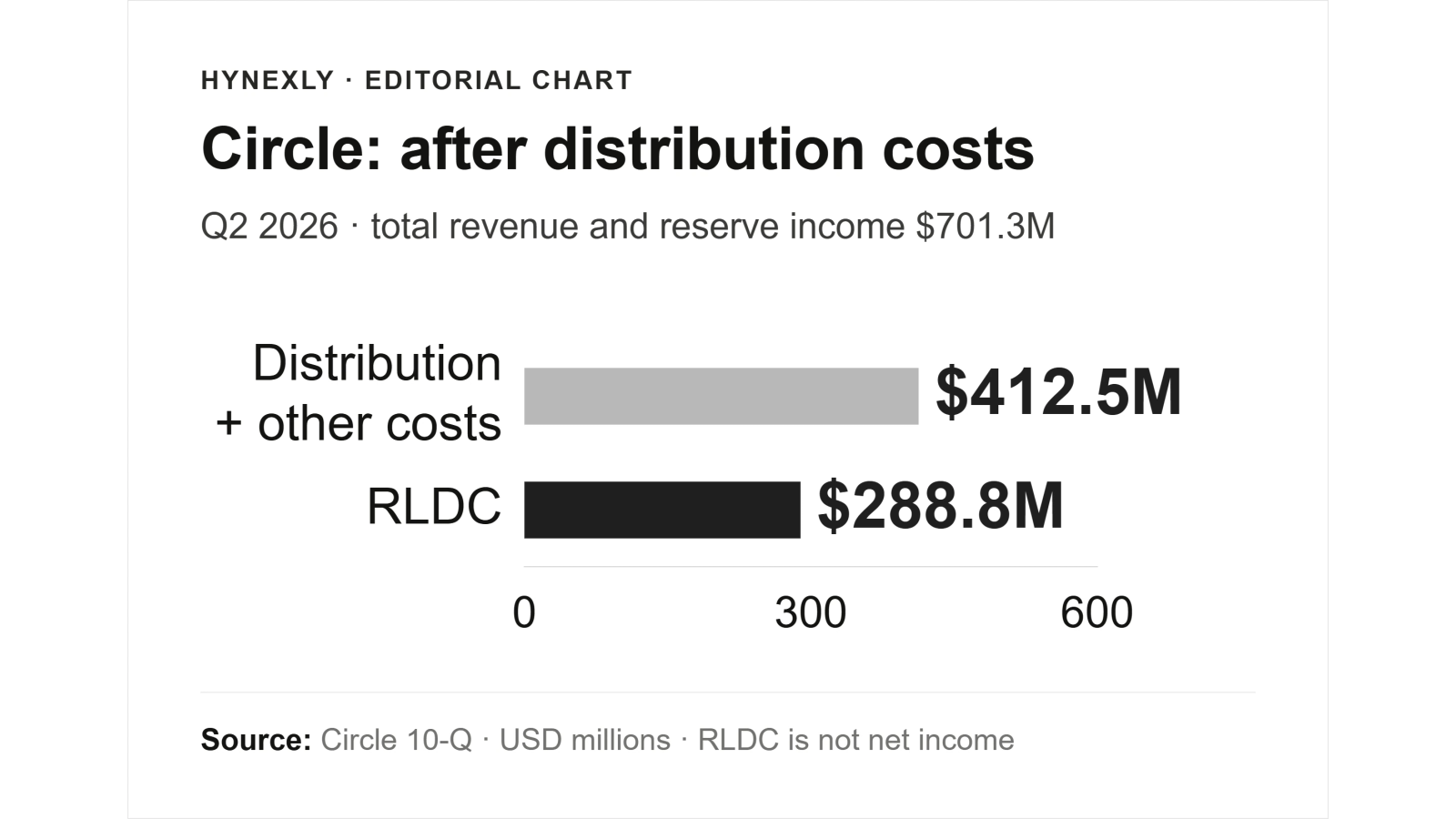
Circle's own model quantifies the first two links. With USDC circulation fixed at the 3/31 level, a hypothetical 100bp increase adds $773M of reserve income and $384M of distribution and transaction costs over the following twelve months. The difference is $389M before operating expenses and taxes—about 34% of annualized Q1 revenue less distribution costs, or RLDC. That is meaningful. It is not a promise to shareholders.

Rate-to-equity map showing a 100bp rate increase passing through reserve income, distribution costs, RLDC and per-share value

Source-derived explanation: Circle Q1 2026 Form 10-Q and article calculation. The SEC sensitivity assumes USDC circulation stays at the 2026-03-31 level and reserve allocation does not change. The $389M is before operating expenses and taxes.

The 30-second caseEvidenceWhat remains unproven
Higher rates lift gross reserve economics+$773M reserve income per +100bpWhether USDC balances hold as opportunity cost rises
Distribution absorbs part of the lift+$384M modeled costWhether partner economics stay stable
Circle retains a positive increment+$389M before opex and taxWhether operating investment consumes it
The stock still has a high hurdle~72× annualized Q1 EPSWhether earnings rise faster than the multiple falls

Thesis: rates are an accelerator, while USDC utility is the engine

The constructive case is not “the Fed hikes, therefore CRCL rises.” It is that Circle owns a rate-sensitive balance engine attached to a growing settlement network. If USDC circulation grows while short-term yields rise, both variables in reserve income—balance and yield—move in the same direction. The distribution bill also rises, but Circle's filing shows that it retains part of the incremental economics.

Q1 2026 demonstrates why the balance matters more than a one-variable rate call. Average USDC circulation grew 39%, while the reserve return rate fell 66bp to 3.5%. Circle attributed about $200.9M of reserve-income growth to the larger balance and a $106.3M reduction to lower yields. The balance effect won: reserve income still rose 17% to $652.5M.

The strongest countercase is also in the filing. Higher interest rates increase the opportunity cost of holding a non-yielding stablecoin instead of a Treasury bill or money-market fund. Circle says the relationship between rates and USDC circulation is complex, uncertain, and unproven. The stock is therefore long two variables, not one: the short-rate level and the utility-driven demand for USDC.

Four conditions required for a rate hike to become equity upside for Circle

Editorial decision map based on Circle's Q1 10-Q. It separates the company-modeled rate effect from the operating and valuation conditions the filing cannot predict.

Source Evidence Snapshot

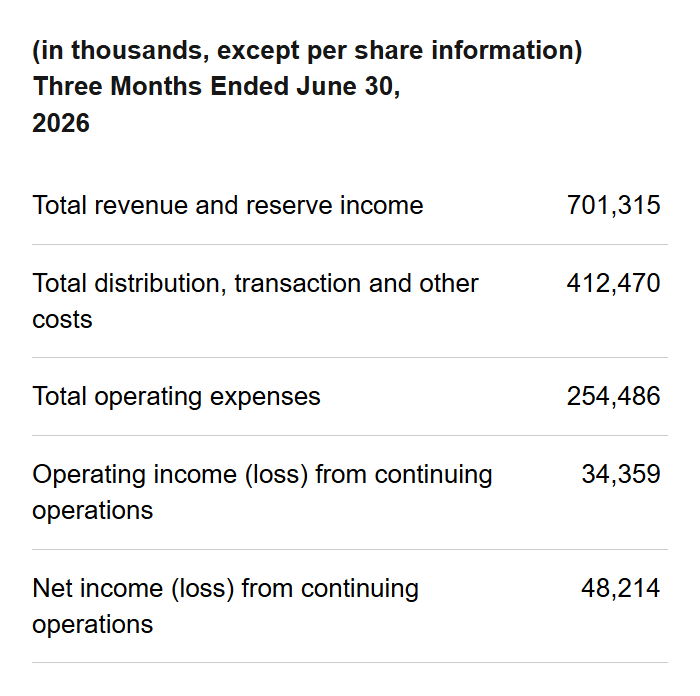
Circle's SEC-filed Q1 release provides the cleanest operating snapshot. Total revenue and reserve income reached $694M, up 20%. RLDC reached $287M, up 24%, and RLDC margin was 41%. Net income from continuing operations fell 15% to $55M because operating expenses rose 76%, while adjusted EBITDA increased 24% to $151M.

Official table showing revenue, RLDC, net income, adjusted EBITDA, USDC circulation, reserve return rate and USDC on platform for Circle Q1 2026
Source capture: Circle Q1 2026 SEC-filed earnings release, page 2, filed 2026-05-11, captured 2026-07-21. RLDC and adjusted EBITDA are company non-GAAP measures; the slide preserves the definitions and units.

Those rows identify both the strength and the leak. USDC circulation was $77.0B at quarter end and $75.2B on average, up 28% and 39%. USDC on Circle's platform ended at $13.7B, while the daily weighted-average platform share rose from 5.7% to 17.2%. A larger direct-platform share matters because the Coinbase collaboration allocates economics partly according to where USDC is held.

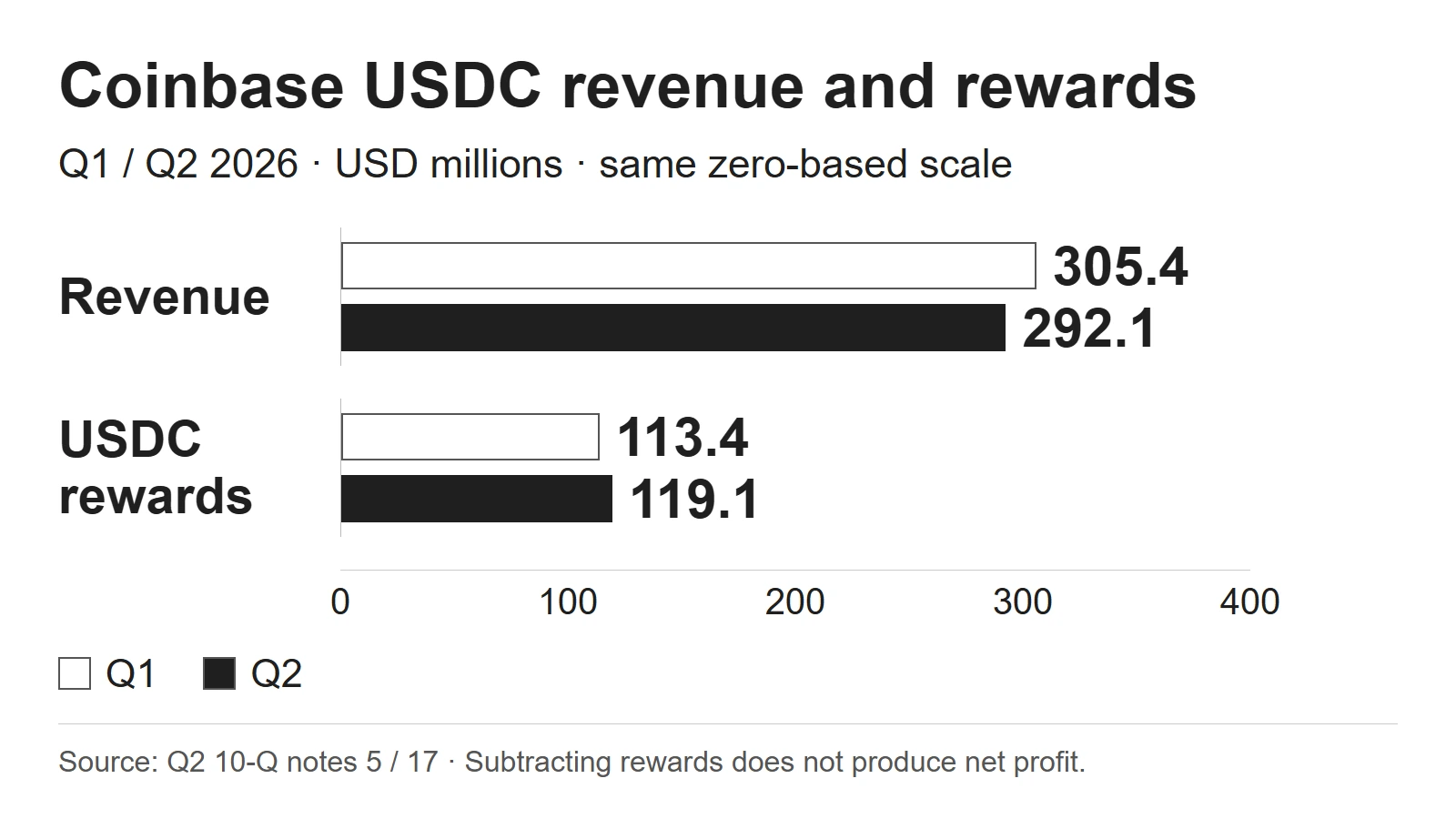
But distribution is expensive. Circle incurred $330.6M of Coinbase-related distribution cost in Q1, up from $303.2M. Total distribution, transaction and other costs were $406.8M. Coinbase receives an allocation tied to USDC held on its platform and half of the remaining broader-ecosystem economics after specified deductions. Circle has sole governance of the stablecoin network, but it does not own all the customer access.

Rebuild the +100bp bridge

The rate sensitivity starts from a 3.49% 2026-03 average yield and holds the $77.049B period-end USDC balance constant. Circle models a $773M reserve-income increase for +100bp and a $384M increase in distribution and transaction costs. Subtracting the second from the first produces a $389M pre-opex increment.

Bridge from $773M of additional reserve income to $389M before operating expenses after $384M of distribution and transaction costs

Source-derived calculation: Circle Q1 2026 10-Q, market-risk section. $773M - $384M = $389M. Comparing it with $287M × 4 = $1.148B of annualized Q1 RLDC gives about 34%. Annualizing one quarter is a scale reference, not a forecast.

The official table is more important than the simplified bridge because it preserves the assumptions. USDC circulation is held constant, rates move immediately and remain constant, all reserve assets are affected equally, and reserve allocation does not change. The table says nothing about operating costs, taxes, share-based compensation, competitive response, or valuation multiples.

Official Circle 10-Q interest-rate sensitivity table showing modeled changes in reserve income and distribution and transaction costs
Source capture: Circle Q1 2026 Form 10-Q, Item 3, filed 2026-05-11, captured 2026-07-21. Values are USD millions and model the following twelve months.

The 2026-06 Federal Reserve target range was 3.50–3.75%. The point of the scenario is not to predict another hike. It is to show the earnings transmission if the policy path moves higher than the 2026-03 yield embedded in Circle's reserves.

What “hegemony” really means for USDC

Circle does not have hegemony in the sense of owning the entire stablecoin market. Its company-defined supply share was 28% at the end of Q1, down about one percentage point year over year. The more defensible claim is that Circle controls several high-value junctions in the dollar-token system.

Control-point map of Circle issuance, reserve trust, distribution, interoperability and transaction flow with Nex as an explainer

Source-derived explanation from the Circle 2025 10-K, Q1 2026 10-Q, reserve transparency page, and CCTP documentation. Nex is explanatory only; the filings and official product pages are the proof.

  1. Issuer control. Circle controls minting, redemption, reserve management, compliance restrictions, and governance of the USDC network. That is the narrowest and strongest control point.

  2. Trust infrastructure. Circle discloses reserve composition weekly, publishes monthly third-party assurance, and says most reserves sit in the BlackRock-managed Circle Reserve Fund. The GENIUS Act's 1:1 liquid-reserve and monthly-disclosure framework raises the regulatory floor; an incumbent already operating near that floor can benefit, although large banks and new permitted issuers can also enter.

  3. Native interoperability. CCTP burns native USDC on one chain and mints it on another after Circle attests to the transfer. The current product page listed 25 supported networks when checked on 2026-07-21. Every integration makes USDC easier to use across applications without wrapped tokens or separate liquidity pools.

  4. Distribution reach. Coinbase, Binance, wallets, exchanges, and financial institutions expand access. This is simultaneously a moat and a toll road that Circle pays to use. Partner reach raises circulation, but weakens retained economics.

  5. Transaction flow. Circle reported that USDC represented 63% of stablecoin transaction volume in Q1 according to Visa Onchain Analytics, versus 28% of the defined supply market. The metrics use different denominators, so they cannot be subtracted. They do suggest that USDC's relevance in movement and settlement is larger than its balance share alone.

Comparison of USDC's 28% supply share and 63% stablecoin transaction-volume share
Source-derived visual: Circle Q1 2026 SEC-filed earnings release. Supply share uses Circle's CoinMarketCap-based definition; transaction-volume share uses Visa Onchain Analytics. The denominators differ.

This is why the better label is control-plane advantage, not monopoly. Circle can define the asset, protect redemption, connect chains, and set technical primitives. It cannot force customers to hold USDC, prevent a regulated competitor from issuing another dollar token, or keep every dollar of distribution economics.

What the market is pricing

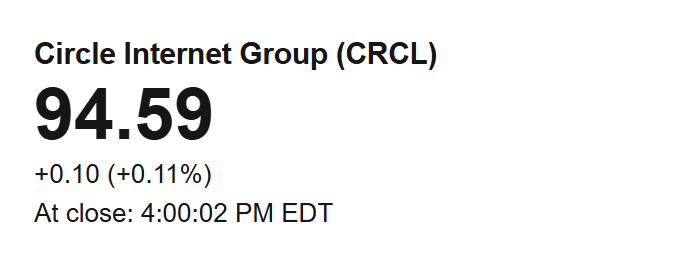
At the 2026-07-17 close of $60.46, CRCL still required substantial growth. Q1 diluted EPS was $0.21. Simply multiplying it by four gives $0.84 and roughly 72× annualized Q1 EPS. Q1 RLDC was $287M; annualizing it gives $1.148B. Using Q1 diluted shares as a scale reference produces roughly 14× annualized RLDC.

Pricing hurdle for Circle at the 2026-07-17 close using annualized Q1 diluted EPS and RLDC

Market snapshot and article calculation from Circle investor stock information and the Q1 earnings release. The quote is delayed. One-quarter annualization ignores seasonality, future rate paths, dilution, investment and tax changes; it is not a fair-value estimate or price target.

That hurdle explains how the stock can rise during a tightening cycle and why the same tightening can still hurt it. A rate increase can push expected RLDC and earnings higher. At the same time, a higher discount rate can reduce the multiple investors pay for distant growth. CRCL rises when the first change is larger than the second.

The bank earnings field guide uses a similar discipline—separate the balance, rate, cost and credit links—but Circle is not a bank. Stablecoin reserves are held for token holders, distribution economics are contractual, and reserve income remains 94% of Q1 total revenue. The JPMorgan adjusted-return bridge is useful for a second reason: strong non-GAAP growth matters only if operating costs and per-share capital convert it into durable shareholder economics.

Risks to the thesis

The first risk is balance elasticity. Yield-bearing alternatives become more attractive as rates rise. If USDC circulation falls enough, the smaller reserve base can offset the higher yield. Circle explicitly declines to predict that behavior.

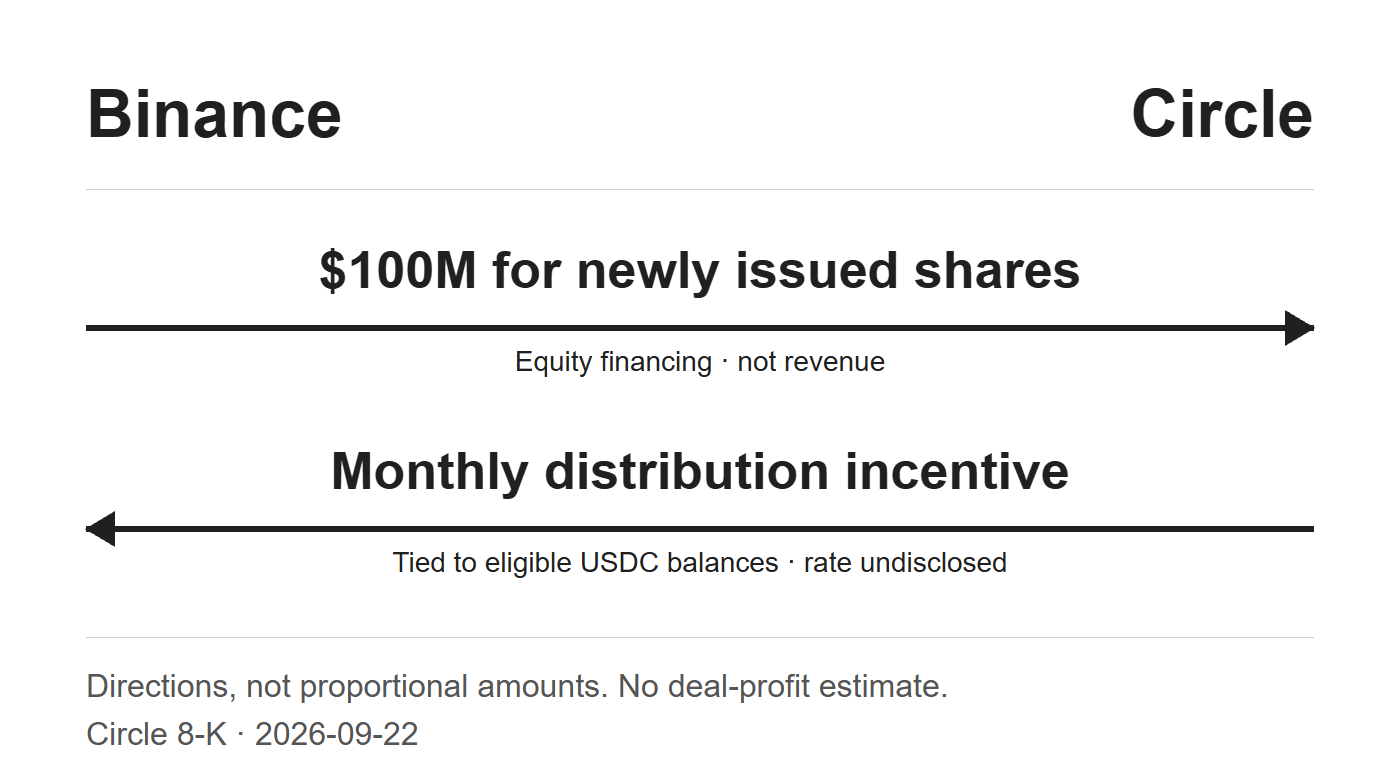
The second is paid distribution. Coinbase-related cost was $330.6M in Q1. Binance and other strategic partners added further cost. If competition for distribution raises the partner share, gross reserve-income growth can coexist with weaker retained economics.

The third is revenue concentration. Reserve income was 94% of Q1 revenue and reserve income. Other revenue doubled to $41.6M, but it remains too small to remove rate and balance dependence.

The fourth is operating investment. RLDC grew 24%, yet net income fell 15% as operating expenses rose 76%, partly because of post-IPO stock compensation and continued product, compliance, and infrastructure investment. Adjusted operating expense still grew 32%.

The fifth is competitive and regulatory inversion. The GENIUS Act can expand the market and reward compliance, but a clearer rulebook also makes entry easier for banks, fintechs, and other permitted issuers. Regulation is a moat only if Circle turns its head start into distribution, developer integration, and lower unit costs.

The sixth is execution beyond USDC. CPN, Arc, agent products, and tokenized funds could diversify revenue. They can also require years of investment, face entrenched competitors, or fail to produce material revenue. They should not be capitalized as proven cash engines before the disclosures support it.

Risk pathCurrent evidenceWeakening signal
USDC balance$77.0B at Q1 endSequential contraction despite higher rates
Distribution leakage$406.8M total Q1 costCost grows faster than reserve income
Market position28% supply; 63% transaction volumeBoth measures decline together
Cost conversionRLDC +24%; net income −15%Opex absorbs the retained rate benefit
DiversificationOther revenue $41.6MReserve income stays near 94% of total

What flips the call

The next filing should answer five linked questions. No Q2 2026 reporting date had appeared on Circle's investor calendar when checked on 2026-07-21, so the trigger is the filing itself rather than an assumed date.

Five next-filing checks for USDC circulation, RLDC margin, USDC on platform, distribution costs and other revenue

Editorial checkpoint based on the Q1 2026 10-Q and earnings release. The 38–40% RLDC margin range is company 2026 guidance; the remaining conditions are editorial monitoring tests.

Watch itemQ1 baselineConstructive conditionWeakening condition
USDC circulation$77.0B end; $75.2B averageHolds or grows as yields riseContracts enough to offset yield
RLDC margin41%At or above the 38–40% FY2026 guideFalls below 38% with higher rates
USDC on platform17.2% daily averageDirect share remains elevatedShare reverses toward distributors
Distribution and other cost$406.8MGrows slower than total revenue and reserve incomeOutgrows the top line
Other revenue$41.6MScales faster than reserve incomeDiversification stalls

The conclusion becomes more constructive if USDC circulation holds, the direct-platform share remains elevated, RLDC margin stays at or above guidance, distribution costs grow more slowly than reserve income, and other revenue keeps scaling. In that configuration, a higher-rate cycle can lift retained economics and the earnings revision can outrun multiple compression.

It weakens if the rate benefit appears only in gross reserve income while circulation, share, margin, and per-share conversion deteriorate. One weak metric would not invalidate the network. A broken transmission chain would.

Methodology and source boundary

The +100bp bridge subtracts Circle's modeled distribution and transaction-cost change from its modeled reserve-income change. The 34% comparison divides the $389M result by four times Q1 RLDC. The valuation snapshot annualizes one quarter and uses the 2026-07-17 delayed close; neither calculation is a company forecast, consensus estimate, fair-value model, rating, or price objective.

Facts, calculations, image captures, and links were rechecked as of 2026-07-21. AI assisted with research organization, chart production, and EN/KO consistency checks; official sources, calculations, and final wording still require owner review before production deployment. No sponsorship or affiliate relationship with Circle, Coinbase, or the cited institutions is disclosed. This is general educational research, not individualized investment advice, an investment rating, or a share-price objective.

Frequently Asked Questions

Yes, if USDC circulation holds. Circle's Q1 2026 10-Q models a 100bp increase as adding $773M of reserve income and $384M of distribution and transaction costs over twelve months, leaving a $389M increase before operating expenses and taxes.

Circle's defensibility comes from controlling USDC issuance and redemption, maintaining regulated and transparent reserves, operating native cross-chain transfer infrastructure, and being embedded across exchanges, wallets, developers, and financial institutions. Distribution is not a pure moat because Circle pays partners such as Coinbase for reach.

The thesis weakens if USDC circulation contracts, supply and transaction share decline together, distribution costs grow faster than reserve income, RLDC margin falls below the company's 38–40% 2026 outlook, or operating investment absorbs the rate benefit.

Sources & evidence

Primary references cited or linked in this analysis. Click through to read each source in full.

  1. 01Circle Q1 2026 Form 10-Q
  2. 02Circle Q1 2026 SEC-filed earnings release
  3. 03Circle 2025 Form 10-K
  4. 04Circle reserve transparency
  5. 05Circle Cross-Chain Transfer Protocol
  6. 06Federal Reserve June 2026 FOMC statement
  7. 07White House GENIUS Act fact sheet
  8. 08Circle investor stock information

Continue the research

Choose the next evidence gap to investigate.
Netflix investor control room showing revenue, operating margin, advertising, and free cash flow clocks

Market & Macro8 min read

Netflix After the Subscriber Scoreboard: A Four-Clock Q2 2026 Test

A disclosure-aware Netflix scorecard for revenue quality, operating margin, advertising, and free cash flow after subscriber additions stopped being the lead metric.

Read the next analysis
Share:
H
Hynexly Research

Owner-operated US market research desk

Owner-operated US stock and market coverage built from public filings, SEC EDGAR, official reports, company releases, and market data.

  • Source-grounded research with primary filings & official reports
  • Bilingual EN / KO editorial workflow
  • Manual editorial QA before publish

Your privacy choices

Choose whether Hynexly may use Google Analytics and personalized AdSense cookies. Necessary cookies always stay on. Change your choice anytime in our Privacy Policy.