SK hynix ADR Trades 33% Above Seoul: What Is the Premium Buying?
Ten SKHY ADRs equal one SK hynix share. The U.S. wrapper recently traded about 33% above FX-adjusted Seoul parity; this is what can close—or preserve—the gap.
Owner-operated US market research desk
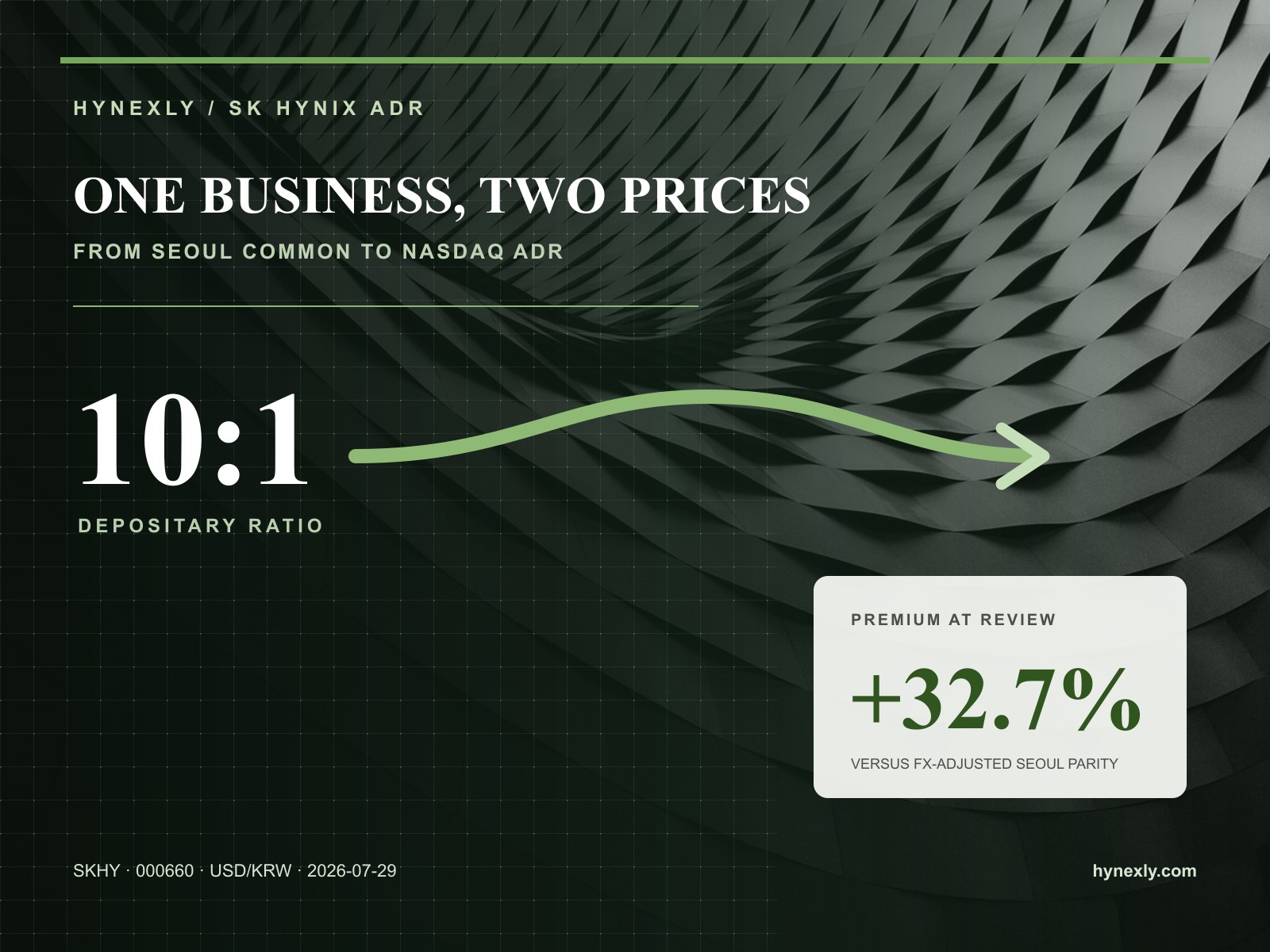
SK hynix now has two highly visible prices for the same operating business. At the 2026-07-29 close, the Seoul common share was KRW1,401,000. Apply the 10:1 ratio and USD/KRW 1,444.3; the value per ADR was about $97.00. SKHY was about $128.68.
That leaves a 32.7% premium in a security designed to represent the same economic claim.
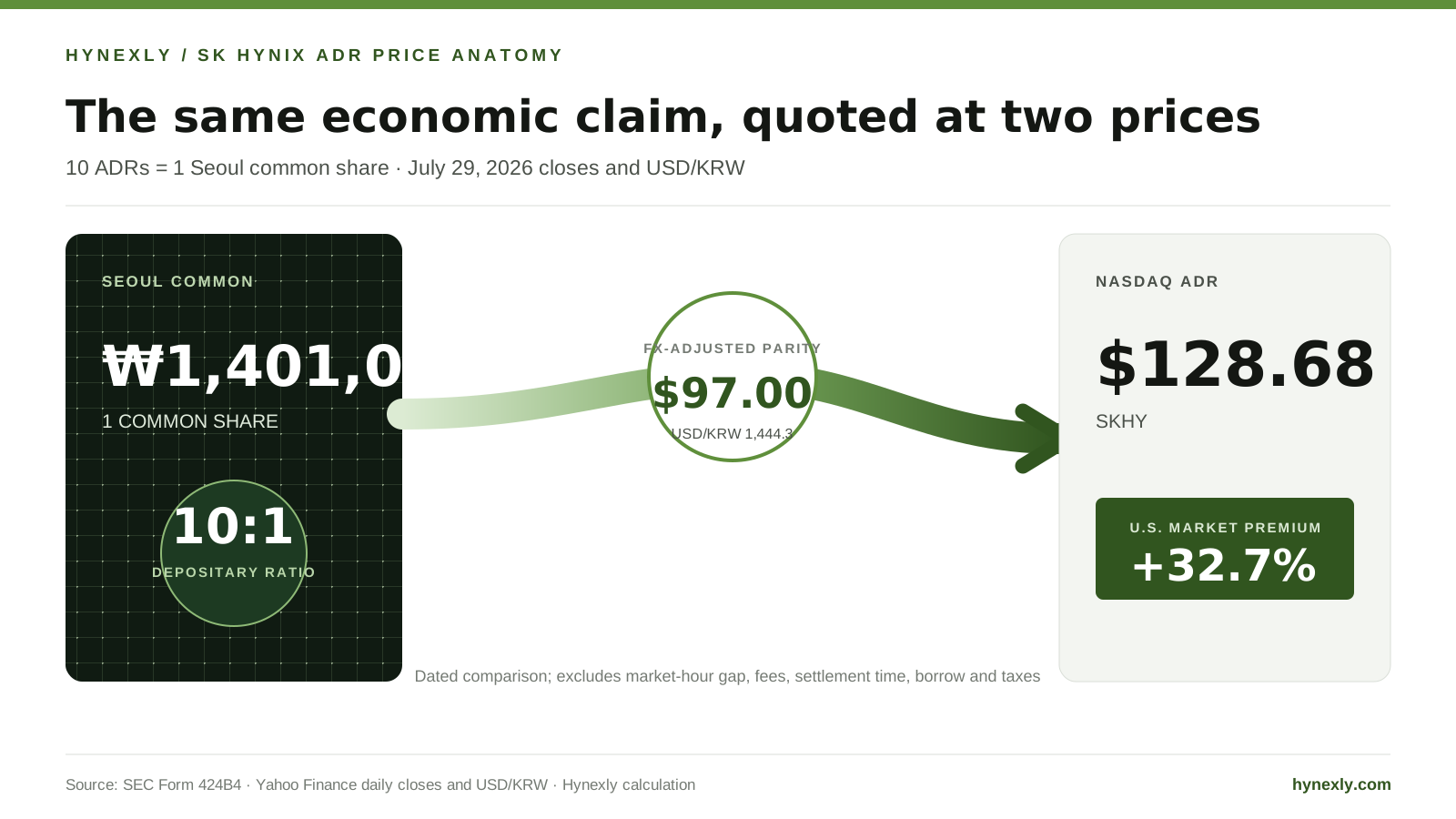
KRW1,401,000 ÷ 10 ÷ 1,444.3 = $97.00; the dated premium equals $128.681 ÷ $97.00 − 1 = 32.7%. The two markets close at different times, so this is a review snapshot—not an executable arbitrage quote.The important distinction is simple. The ADR improves access. It does not improve SK hynix's factories, HBM pricing, margins or cash generation. A temporary premium can survive because the U.S. wrapper is convenient and newly listed supply is still finding its owners. A lasting premium must survive an increasingly open conversion path.
The ADR is a wrapper, not a better business
The SEC prospectus defines the instrument precisely: the offer included 177.9M American Depositary Shares; 1 ADS represents 0.1 common share. The comparison unit is 10 SKHY ADRs against 1 Seoul-listed share.
This sounds obvious, but it prevents the most common analytical mistake. SKHY and ticker 000660 are not two companies with independent fundamentals. They are two routes to exposure, with different currencies, trading hours, custody arrangements and market participants.

The offer also changed the capital structure. SK hynix issued 17.79 million new common shares to Citibank as depositary. The prospectus put that at about 2.5% of the 712.70 million common shares outstanding before issuance. Existing shareholders therefore received the benefit of a much larger global capital pool alongside real dilution.
Gross proceeds were $26.5071 billion, with net proceeds estimated at about $26.2 billion. The filing says the money may fund general corporate purposes, including capital expenditure. It specifically describes the Yongin Fab 1 project, P&T7 advanced-packaging capacity in Cheongju and EUV equipment. The ADR is therefore not merely a trading wrapper; its launch financed a much larger manufacturing plan.
The clean thesis is narrower than “the U.S. market values SK hynix more.” The U.S. market was paying more for the route to the shares at this snapshot. Whether it continues to do so depends on supply and friction.
Source Evidence Snapshot
The first proof is the contractual ratio. The official offering document says both how many ADSs were sold and what each ADS represents.
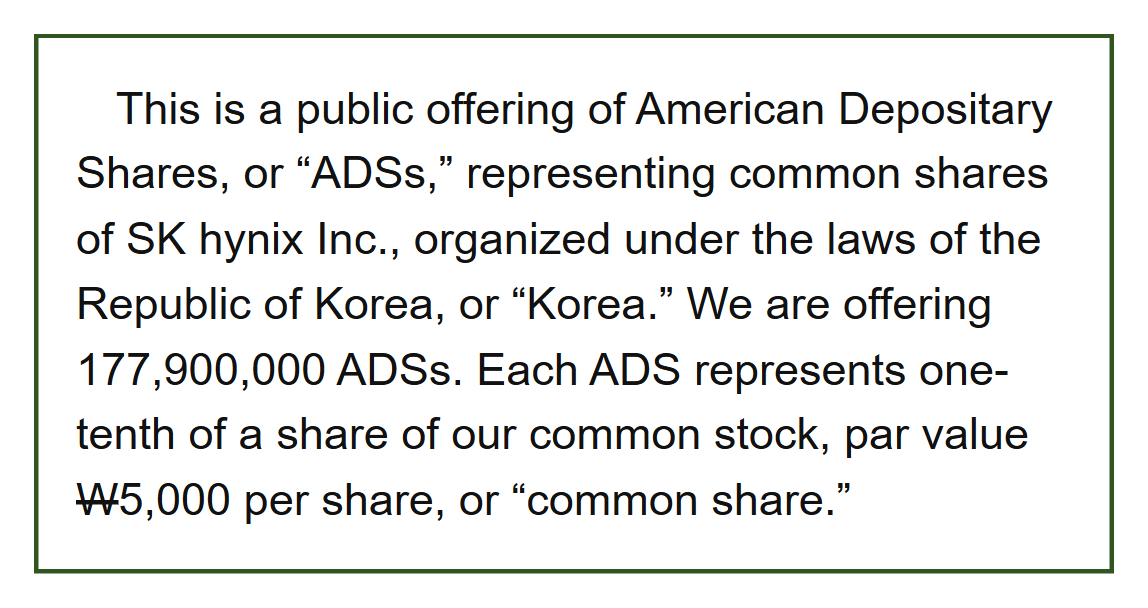
2026-07-09, captured 2026-07-30. The excerpt establishes the 10:1 comparison unit.The second proof is the capital increase. The later Form 6-K records the actual 17.79 million new shares, the KRW39.8905 trillion issuance amount and the transfer to Citibank.
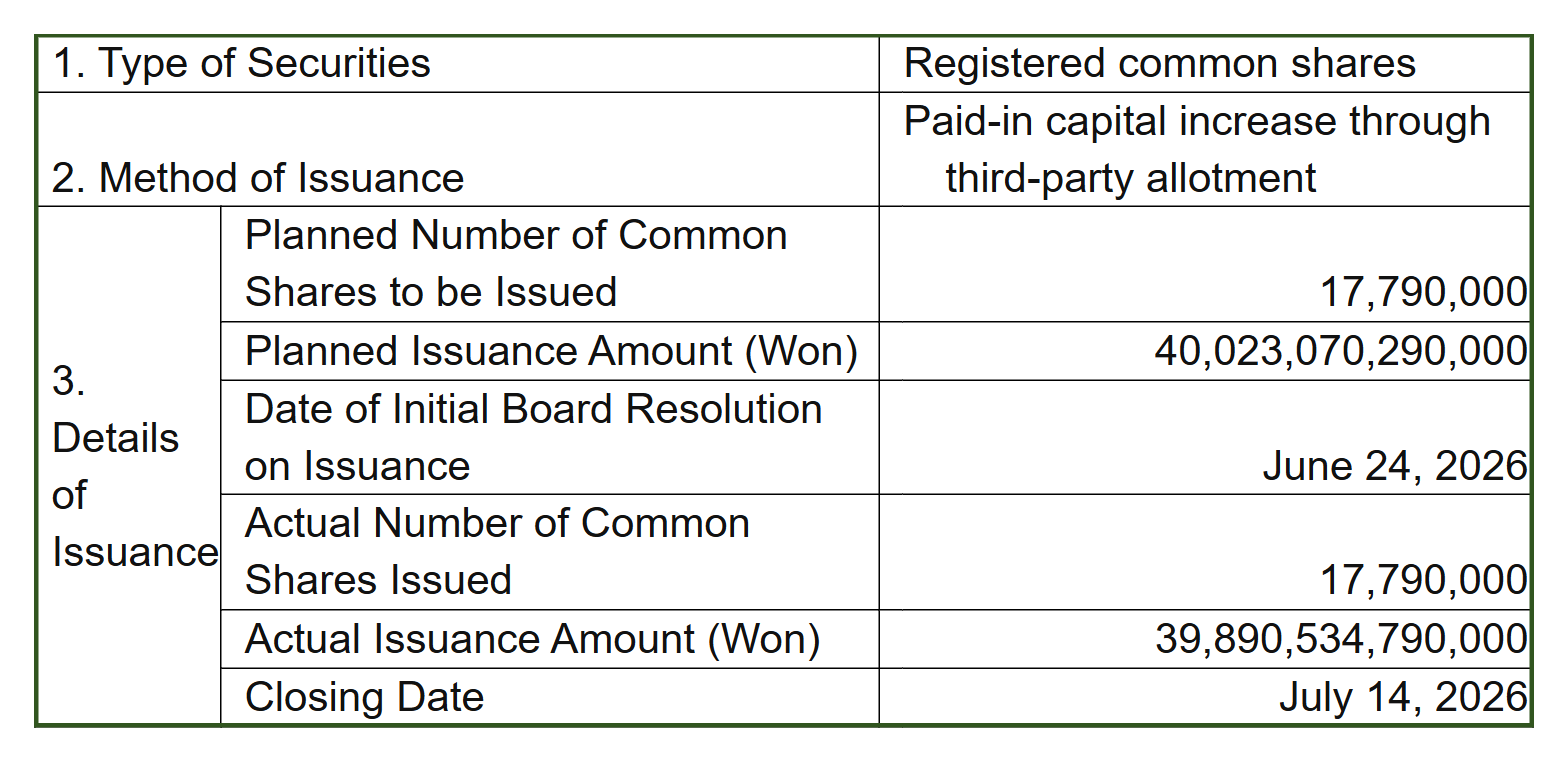
2026-07-15 Form 6-K, captured 2026-07-30. The filing identifies Citibank as depositary and the new shares as the basis for the ADRs.The operating business underneath the wrapper was not standing still. Preliminary Q2 figures showed KRW79.319 trillion of revenue and KRW60.543 trillion of operating profit. Revenue increased 50.9% from Q1 and 256.8% from the prior year; operating profit rose 61.0% sequentially and 557.2% year over year.
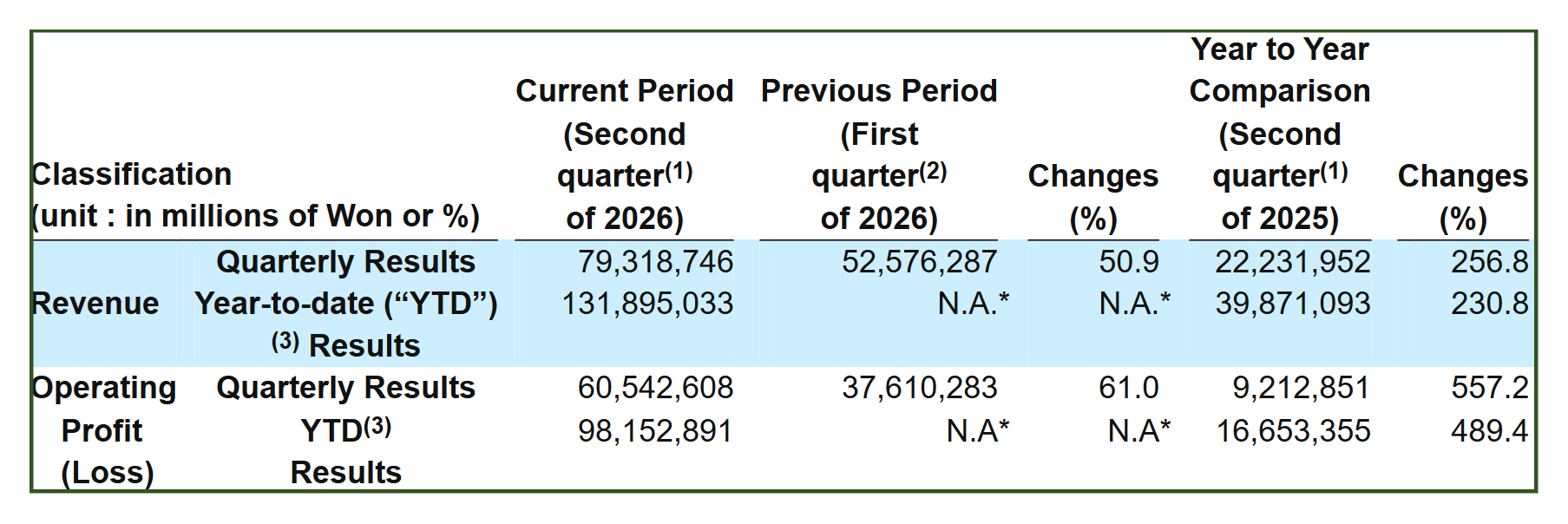
2026-07-29 Form 6-K, captured 2026-07-30. Figures are preliminary, unaudited and reported under K-IFRS; units are millions of won except percentages.Those results help explain demand for access. They do not explain a precise 32.7% premium. Strong HBM economics belong in the value of both securities. Only differences in access, supply, currency and trading mechanics belong in the gap between them.
The conversion channel is the pressure valve
Citi's official depositary notice identifies SKHY, the 1 ordinary share : 10 DRs ratio and a 2026-07-29 open date for issuance and cancellation. That date matters because a closed or restricted book can preserve scarcity. An open book creates a route—subject to practical constraints—for Seoul shares and ADRs to move toward economic equivalence.
The route is not frictionless. Market hours do not overlap fully; FX can move between closes; custody, settlement, fees, taxes and borrow matter. A screen-level spread is not automatically harvestable. But as issuance and cancellation become routine, a premium caused only by launch scarcity should face more supply.
What the Street Is Pricing
The price path already shows that access premiums can compress quickly. SKHY was sold at $149; its debut close was $168.01. It reached $171.94 on 2026-07-21 and finished 2026-07-29 near $128.90.
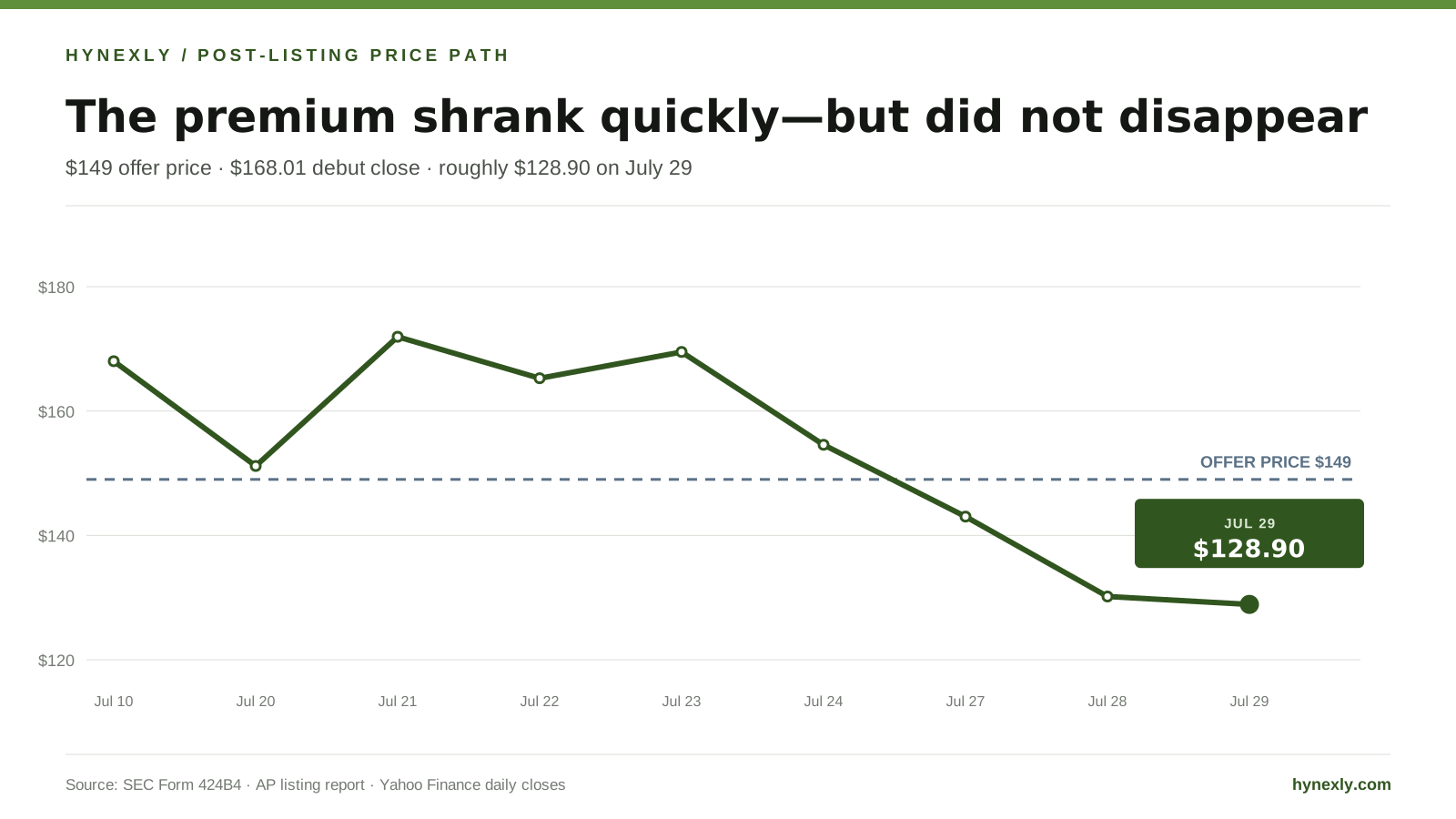
The fall below the offer price did not remove the cross-market premium because the Seoul share and FX rate also determine parity. This is why an ADR chart alone is incomplete. The useful dashboard has three live fields: SKHY, 000660, and USD/KRW.
Large investors showed demand, not a unified forecast
The prospectus says Baillie Gifford Overseas, Coatue-managed funds and Situational Awareness Partners had indicated interest in up to $7 billion of ADSs in aggregate. That amount equals about 26.4% of the gross offer.
The same paragraph makes the boundary equally important: the indications were nonbinding. The investors could buy more, fewer or no ADSs. This is evidence that the book attracted sophisticated demand; it is not proof of their final allocations, current positions or price outlooks.

Short interest is meaningful only with the right denominator
The first reported short-interest snapshot showed about 14.86 million SKHY shares short for the 2026-07-15 settlement date, with 0.49 days to cover. That is roughly 8.35% of the 177.9 million ADSs in the initial offer.
It should not be called 8.35% of free float. ADR creation, global common-share ownership and the short reporting date make the true tradable denominator more complicated. Short interest also cannot tell us whether positions hedge Seoul exposure, express a premium-convergence trade or reflect a bearish view of the company. It is positioning evidence, not a forecast.
The market is therefore pricing several things at once:
| Layer | What the review snapshot can support | What it cannot prove |
|---|---|---|
| Operating business | Exceptional preliminary Q2 revenue and operating-profit growth | That the memory cycle or HBM pricing will remain this strong |
| U.S. access | Investors paid for a liquid Nasdaq route to the company | That the wrapper deserves a permanent premium |
| Launch supply | A new instrument can remain scarce while ownership settles | That scarcity survives open, routine conversion |
| Positioning | Reported short interest was material beside the initial offer | Whether shorts are directional, hedged or still open |
The cleanest interpretation is an expectation gap: the business explains why investors wanted SK hynix; market structure explains why the U.S. wrapper could temporarily cost more.
Risks to the Thesis
The first risk is premium collapse without business deterioration. SK hynix can keep reporting strong HBM demand while SKHY falls relative to Seoul. That would be a wrapper repricing, not necessarily an operating warning.
The second is dilution plus capex execution. The new shares were about 2.5% of pre-issue common shares. The capital is large enough to expand fabs and advanced packaging, but those projects must turn spending into productive capacity and cash. A memory downcycle during the build would make that conversion harder.
The third is ADR-specific friction. ADR holders rely on the deposit agreement, custody chain and currency conversion. Fees, taxes, voting mechanics and settlement are not identical to direct Seoul ownership.
The fourth is measurement error. A 32.7% figure built from non-synchronous closes can overstate or understate the live gap. The right test uses several sessions, aligned timestamps where possible and the same FX convention each time.
The fifth is cycle extrapolation. Preliminary Q2 results were extraordinary, but they are preliminary and unaudited. High operating margins attract capacity, customer negotiation and competition. An ADR premium cannot protect investors from a change in memory pricing or HBM execution.
| Risk | Evidence to watch | What would make it worse |
|---|---|---|
| Wrapper repricing | SKHY premium versus aligned Seoul parity | SKHY falls while 000660 and operating estimates hold |
| Conversion supply | Citi issuance/cancellation status and ADR count | Supply expands while the premium closes abruptly |
| Capital intensity | Yongin, P&T7 and EUV spending milestones | Capex rises faster than productive output and cash |
| Memory cycle | HBM mix, DRAM pricing and customer concentration | Pricing weakens before new capacity earns its cost |
What Flips the Call
The current call is not “the premium must vanish tomorrow.” It is: access and launch scarcity can support a near-term gap, but an open conversion mechanism should challenge a purely mechanical premium.

The thesis strengthens if ADR issuance and cancellation remain open, converted supply grows and the synchronized premium keeps contracting. That would show the pressure valve working.
It weakens if the book repeatedly closes, settlement frictions remain material or the comparison stays noisy because liquidity is thin. Those conditions can preserve a convenience premium longer than a simple parity formula suggests.
It flips if the channel is demonstrably open, converted supply rises and a material premium survives through a full monthly cycle. At that point, “temporary launch scarcity” is no longer a complete explanation. The analysis would need to identify a durable segmentation benefit—or admit that the market is paying a persistent convenience price.
The next update should record the same four numbers on the same basis: SKHY, 000660, USD/KRW and Citi book status. A fifth—reported short interest—helps show whether convergence has become a crowded position.
Method and Disclosure
The parity calculation uses the 2026-07-29 closes: SKHY at $128.681, SK hynix common at KRW1,401,000, USD/KRW at 1,444.3, and 1 common share per 10 ADRs. Parity is 1,401,000 ÷ 10 ÷ 1,444.3 = $97.00; premium is 128.681 ÷ 97.00 − 1 = 32.7%. Market hours differ, so the result is a dated comparison rather than a tradable quote. It excludes depositary fees, taxes, settlement time and borrow.
The dilution reference uses the prospectus's pre-issue denominator: 17.79 million new common shares were about 2.5% of 712.70 million common shares outstanding. On a simple post-issue denominator, the new shares represent about 2.44%; the article uses the company's disclosed pre-issue comparison.
The $7 billion cornerstone figure is an aggregate, nonbinding indication of interest divided by the $26.5071 billion gross offering. It is not treated as a final allocation or current hedge-fund position. The 14.86 million short-interest figure is compared with the initial ADS offer only; it is not labeled as a free-float percentage.
For the operating side of the memory cycle, read the Micron contract-and-margin test. For the AI demand chain that pulls HBM into accelerators, use the Nvidia Blackwell cash-conversion test.
Facts, calculations, captures, image rights and bilingual parity were reviewed on 2026-07-30. AI assisted with structure and consistency checks; claims were tied to the cited filings and dated market data. No sponsorship or affiliate relationship with SK hynix, Citi or the named investors is disclosed. This is general information, not individualized investment advice, and it does not issue a rating or price objective.
Frequently Asked Questions
The Nasdaq-listed ADR trades under SKHY. Each ADR represents one-tenth of one SK hynix common share, so ten SKHY ADRs correspond to one Seoul-listed common share before fees, taxes, settlement and other frictions.
Possible reasons include easier U.S. access, launch-period scarcity, different market hours, foreign-exchange movement, settlement time, fees and borrow constraints. None changes the underlying operating economics, so persistent issuance and cancellation should pressure a purely mechanical gap.
Using SKHY at $128.681, SK hynix common stock at KRW1,401,000, USD/KRW at 1,444.3 and the ten-to-one ratio, FX-adjusted parity was about $97.00 per ADR. The resulting dated premium was approximately 32.7%.
Yes. SK hynix issued 17.79 million new common shares for the depositary. The prospectus described that amount as about 2.5% of the 712.70 million common shares outstanding before the issuance.
No. The July 15 settlement snapshot showed about 14.86 million shares short, but it is a delayed positioning measure. It was about 8.35% of the initial 177.9 million ADS offer, not a reliable percentage of freely tradable global economic exposure.
Primary references cited or linked in this analysis. Click through to read each source in full.
- SK hynix Form 424B4 prospectus
- SK hynix July 15, 2026 Form 6-K
- SK hynix July 29, 2026 preliminary Q2 Form 6-K
- Citi SKHY issuance and cancellation notice
- Nasdaq SK hynix listing announcement
- Yahoo Finance SKHY historical data
- Yahoo Finance SK hynix Seoul historical data
- Nasdaq SKHY short interest
- unsplash.com/photos/j0g8taxHZa0
- unsplash.com/photos/b5POxb2aL9o
Choose the next evidence gap to investigate.
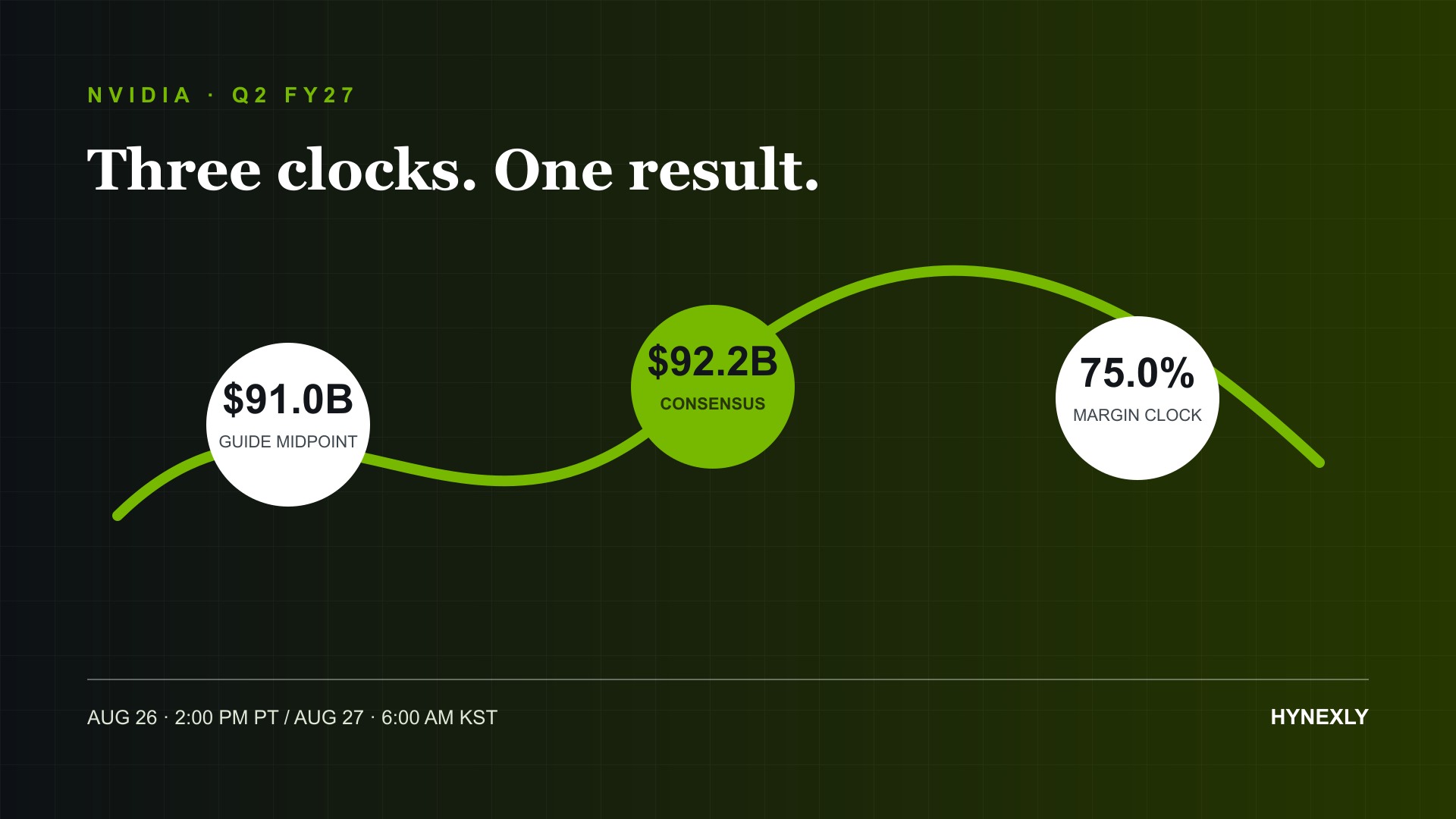
Nvidia Earnings Tomorrow: Why a $92.2B Quarter Is Only the First Test
Nvidia reports Q2 FY2027 on August 26. The guide, consensus, margin bridge, Data Center mix, China boundary, and Q3 test in one evidence-led scorecard.
Owner-operated US market research desk
Owner-operated US stock and market coverage built from public filings, SEC EDGAR, official reports, company releases, and market data.
- Source-grounded research with primary filings & official reports
- Bilingual EN / KO editorial workflow
- Manual editorial QA before publish